
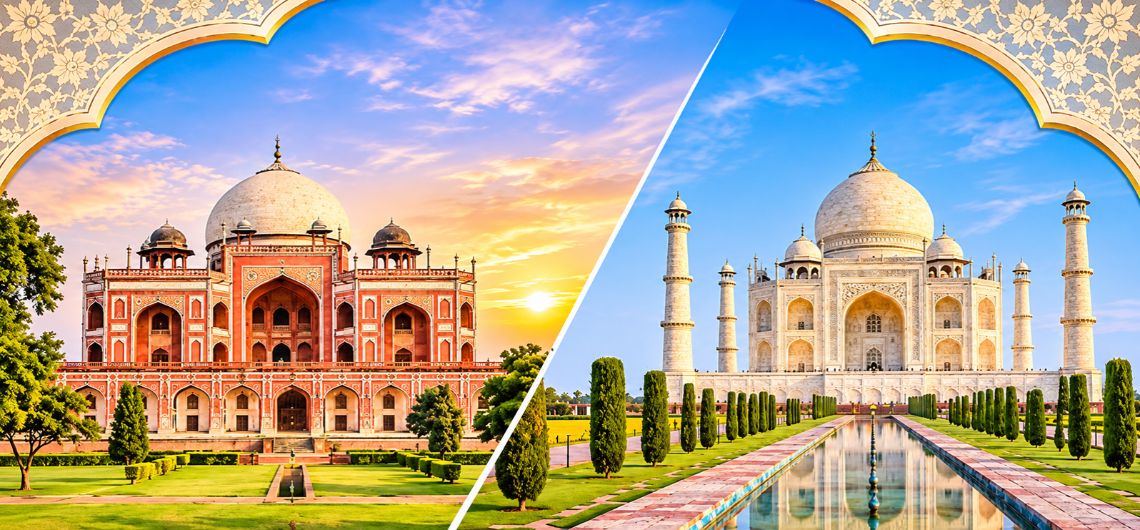
Stand in front of Humayun’s Tomb in Delhi and then the Taj Mahal in Agra, and you may feel an odd sense of recognition. A tall, symmetrical mausoleum rises from a platform, a bulbous dome crowns the skyline, and a geometric garden spreads out on every side. That resemblance is no accident. Built roughly seventy years apart, both monuments express the Mughal idea of an imperial tomb as a paradise on earth, shaped by Persian ideas and refined by Indian craftsmanship. Humayun’s Tomb, completed in 1572, set the pattern for the Mughal garden tomb at monumental scale. The Taj Mahal, begun in 1632, carried that pattern to a level of polish few buildings have matched. This guide compares them side by side, so you can read the story of Mughal architecture in the stone.
Historical Background of Humayun’s Tomb and the Taj Mahal
The two tombs belong to different generations of the same dynasty. One was raised under Akbar, the other under his grandson Shah Jahan, and the gap between them explains most of what you see.
The Story Behind Humayun’s Tomb
Humayun, the second Mughal emperor, died in 1556. His chief consort, Bega Begum (also known as Haji Begum), commissioned his tomb in Delhi, and construction ran from about 1565 to 1572, during the reign of his son Akbar. The designer was Mirak Mirza Ghiyas, a Persian architect from Herat, working with his son Sayyid Muhammad, who is recorded as continuing the work.
Its importance is hard to overstate. It was the first garden tomb on the Indian subcontinent and the first Mughal building to use red sandstone on such a scale. Later imperial tombs, including the Taj Mahal, built on the ideas first tested here.
The Story Behind the Taj Mahal
Shah Jahan commissioned the Taj Mahal after his wife, Mumtaz Mahal, died in 1631. Soon afterward, construction began in 1632 on the south bank of the Yamuna River in Agra. Workers completed the main mausoleum by 1643. Meanwhile, they continued building the surrounding mosque, guest house, gateway and gardens until around 1653.
A board of architects supervised the project under the leadership of court architect Ustad Ahmad Lahori. In addition, thousands of craftsmen from across the empire and beyond contributed their skills. The designers also studied earlier Timurid and Mughal tombs, including the Gur-e Amir in Samarkand, Humayun’s Tomb and the tomb of Itimad-ud-Daula in Agra. As a result, they created a masterpiece that many consider the finest completed expression of Mughal architecture.
Architectural Similarities Between the Taj Mahal and Humayun’s Tomb
Place photographs of the two tombs next to each other and the shared grammar is clear. Both follow the same basic idea: a monumental, domed mausoleum standing in a formal garden.
Persian Influence in Mughal Architecture
The Mughals came from the Timurid world of Central Asia and admired Persian art, so Persian ideas run through both buildings. You can see them in the large arched recesses called iwans, the double-shell dome, the use of calligraphy, and the garden-as-paradise concept. Humayun’s Tomb was designed by a Persian architect from Herat. The Taj Mahal was built by a mixed team of Persian, Central Asian and Indian specialists. Both buildings are Persian in vocabulary but Indian in execution.
Symmetry and Geometric Planning
Both tombs sit on a square, symmetrical plan with chamfered (angled) corners, so the building looks nearly octagonal. Inside, each follows the hasht bihisht, or “eight paradises” plan: a central burial chamber surrounded by eight smaller rooms connected by passages. Walk around either monument and every side looks almost identical, which is exactly the point.
Charbagh Garden Layout
Both tombs stand in a charbagh, a garden divided into four parts by raised walkways and water channels, echoing the four rivers of paradise described in Islamic tradition. At Humayun’s Tomb, the mausoleum rises from the middle of the garden where the channels cross. The Taj Mahal follows a similar garden layout. However, its designers placed the tomb at the far end of the garden, on a raised terrace above the Yamuna River. As a result, the water channels naturally draw visitors’ eyes towards the magnificent mausoleum.
Domes, Arches and Minarets
Both tombs are crowned by a large double dome, with an outer shell for the skyline and an inner shell for the interior. Both use tall pointed arches framing the entrances and surrounded by smaller arched niches. Small domed pavilions called chhatris decorate the roofline of each. The main difference is that the Taj Mahal adds four freestanding minarets at the corners of its platform, a feature Humayun’s Tomb does not have.
Elevated Platforms and Monumental Design
Each tomb stands on a high platform, which lifts the building above the garden and gives it a commanding presence. At Humayun’s Tomb the platform is roughly 7 metres high and holds rows of arched cells. At the Taj Mahal, a raised terrace carries the white mausoleum, so the building seems to float above the gardens.
Major Architectural Differences Between the Two Monuments
The similarities are structural. The differences are mostly in surface, proportion and finish, and they show how far Mughal taste moved in seven decades.
Red Sandstone vs White Marble
Humayun’s Tomb features warm red sandstone, while its dome and decorative outlines around arches and panels showcase white marble. As a result, the building creates a bold, earthy and striking appearance. In contrast, the Taj Mahal features an entirely white marble exterior over a brick core, while its surrounding supporting buildings use red sandstone. Moreover, the marble changes colour from dawn to dusk, giving the Taj Mahal its famous glow.
Decorative Elements and Craftsmanship
- Humayun’s Tomb: crisp geometric patterns created by contrasting marble against sandstone, plus carved stone screens (jalis) that filter light into the interior.
- Taj Mahal: pietra dura inlay, in which semi-precious stones are cut and set into marble in flowing floral designs, alongside fine relief carving and delicate marble lattice screens.
- Calligraphy: Quranic inscriptions in black stone frame the Taj Mahal’s arches. The lettering is scaled so it appears even from the ground, a subtle optical correction.
Architectural Shape and Structural Design
Humayun’s Tomb is broad and sturdy, about 47 metres tall, with a dome that sits relatively low on the building. The Taj Mahal rises to about 73 metres, with a taller drum under a more elongated dome, four minarets and four corner pavilions that frame it from every angle. Humayun’s complex also holds many other tombs, while the Taj complex is organised around one mausoleum, flanked by a mosque and a matching guest house.
Scale, Elegance and Artistic Refinement
Humayun’s Tomb shows a young tradition testing its ideas at scale. The Taj Mahal shows the same ideas controlled down to the last proportion: minarets, gateway, gardens and flanking buildings all work together as one composition. The Taj is not only bigger, it is more coordinated.
How Humayun’s Tomb Influenced the Architecture of the Taj Mahal
The Taj Mahal was not copied from Humayun’s Tomb. It was the high point of a tradition that Humayun’s Tomb helped start, alongside other influences such as Timur’s tomb in Samarkand and Itimad-ud-Daula’s tomb in Agra. Several steps connect them:
- Garden-tomb design: Humayun’s Tomb introduced the monumental charbagh tomb to India. The Taj Mahal reworked the idea by moving the tomb to the riverbank.
- Central planning: the nine-part hasht bihisht plan and strict symmetry carried over from one to the other.
- Double dome: both tombs use a dome that works on two levels, with the Taj’s more slender and taller.
- From sandstone to marble: red sandstone with marble accents gave way to pure white marble.
- Refinement: bold geometric contrast gradually turned into delicate inlay and harmonious proportion.
That is why historians often call Humayun’s Tomb a precursor to the Taj Mahal: a landmark on the road, not a blueprint.
Taj Mahal vs Humayun’s Tomb: Key Differences at a Glance
| Architectural Feature | Humayun’s Tomb | Taj Mahal |
|---|---|---|
| Location | Delhi | Agra |
| Construction Period | c. 1565–1572 | 1632 onwards (main mausoleum c. 1643; complex c. 1653) |
| Commissioned By | Bega Begum (Haji Begum) | Shah Jahan |
| Lead Architect | Mirak Mirza Ghiyas, with his son Sayyid Muhammad | Ustad Ahmad Lahori, with a board of architects |
| Main Material | Red sandstone and white marble | White marble |
| Architectural Influence | Persian and Timurid traditions | Persian, Timurid and Indian influences |
| Garden Design | Charbagh, with the tomb at the centre | Charbagh-inspired layout, with the tomb at the river end |
| Approximate Height | About 47 m | About 73 m |
| Main Purpose | Imperial mausoleum | Imperial mausoleum |
| UNESCO Recognition | 1993 | 1983 |
UNESCO World Heritage Significance
The Taj Mahal was inscribed on the UNESCO World Heritage List in 1983, recognised as a masterpiece of human creative genius and described by UNESCO as the jewel of Muslim art in India. Humayun’s Tomb followed in 1993, under criteria (ii) and (iv), as an outstanding early example of the Mughal garden tomb and a building that shaped later Mughal architecture.
Together they preserve the story of how Mughal architecture developed, and both are central to India’s cultural identity. Humayun’s Tomb in particular has benefited from a major conservation effort led by the Aga Khan Trust for Culture with the Archaeological Survey of India, which restored its gardens and water channels.
Can You Visit Humayun’s Tomb and the Taj Mahal on the Same India Trip?
Yes, and seeing them in sequence is the best way to understand the connection. Humayun’s Tomb stands in Nizamuddin East in Delhi, close to Hazrat Nizamuddin railway station. The Taj Mahal is in Agra, roughly 200 km to the south. The road journey usually takes three to four hours, and fast trains cover the distance in around two hours, so the two cities fit comfortably into one itinerary.
Visiting Delhi first is the logical order. You meet the prototype, with its red sandstone, sturdy proportions and sweeping garden, and then travel to Agra to see how those ideas matured. A guided day in the capital, such as an Old and New Delhi sightseeing tour, is a good way to place Humayun’s Tomb alongside other Mughal landmarks like the Red Fort and Jama Masjid, so the dynasty’s story makes sense before you reach the Taj.
What to Notice When Visiting These Mughal Monuments
A few details turn a sightseeing stop into a lesson in architecture:
- Symmetry: stand on the central axis and see how each side mirrors the other.
- Domes and arches: look for the pointed arches and the way the dome sits on its drum.
- Sandstone and marble: see where each material is used, and what it does to the mood of the building.
- Decorative patterns: compare Humayun’s bold geometry with the Taj’s flowing inlay.
- Garden layouts: trace the water channels and walkways, and find where the tomb stands in each.
- Surroundings: notice how the Taj faces the river, while Humayun’s Tomb sits inside a walled garden among other monuments.
A practical tip: the Taj Mahal is closed to visitors on Fridays, so plan your Agra day around it.
Experience the Architectural Beauty of the Taj Mahal in Agra
Photographs flatten the Taj Mahal. In person, you notice how the four minarets lean very slightly outward, how the marble shifts from pearly white to gold to soft grey through the day, and how the inlaid flowers are made of tiny cut stones. You also feel the proportions: the gateway frames the tomb as you approach, then falls away to reveal it whole.
If you are travelling from Delhi, arranging a comfortable ride makes the day far easier. A private journey such as a Taj Mahal Tour By Luxury Car lets you reach Agra without logistics, and leaves time to explore the Taj and other Mughal landmarks in the city at an unhurried pace. Go early if you can, when the light is soft and the complex is quieter.
Frequently Asked Questions
Is Humayun’s Tomb older than the Taj Mahal?
Yes. Builders constructed Humayun’s Tomb between about 1565 and 1572. In comparison, work on the Taj Mahal began in 1632, roughly 60 years later.
Did Humayun’s Tomb inspire the Taj Mahal?
It was one of several influences. The Taj Mahal’s designers also drew on Timurid tombs such as the Gur-e Amir in Samarkand, and on the tomb of Itimad-ud-Daula in Agra. Humayun’s Tomb is best seen as an important predecessor, not a model that was copied.
What are the similarities between Humayun’s Tomb and the Taj Mahal?
Both are imperial mausoleums set in charbagh gardens. Both have symmetrical plans, raised platforms, double domes, large arched recesses and a Persian-influenced design vocabulary.
Why is Humayun’s Tomb called the predecessor of the Taj Mahal?
Because it was the first monumental garden tomb in India, and it established the layout, the double dome and the symmetrical plan that the Taj Mahal later refined.
Which monument is larger, Humayun’s Tomb or the Taj Mahal?
The Taj Mahal is taller, at about 73 metres compared with roughly 47 metres for Humayun’s Tomb. Humayun’s Tomb stands in a large garden complex with several other tombs.
What is the main architectural difference between the two monuments?
Material and refinement. Humayun’s Tomb is red sandstone with white marble highlights and bold geometry. The Taj Mahal is white marble with delicate inlay and four minarets.
Can tourists visit Humayun’s Tomb and the Taj Mahal on the same trip?
Yes. Delhi and Agra are about 200 km apart and easily combined, by road in three to four hours or by a faster train. Many travellers see Humayun’s Tomb in Delhi first, then the Taj Mahal in Agra.
Conclusion – Two Monuments, One Remarkable Mughal Legacy
Humayun’s Tomb and the Taj Mahal are two chapters of one architectural story. The first introduced the garden tomb, the double dome and the symmetrical plan to India at monumental scale. The second took those ideas, added white marble, inlay and a perfectly judged composition, and made them timeless. Neither monument diminishes the other; each is easier to appreciate once you have seen both.
If you are planning a journey through India’s past, let these two tombs guide you. Walk the gardens in Delhi, travel to Agra, and let the stone tell you how an empire’s taste evolved.