<!-- wp:paragraph -->
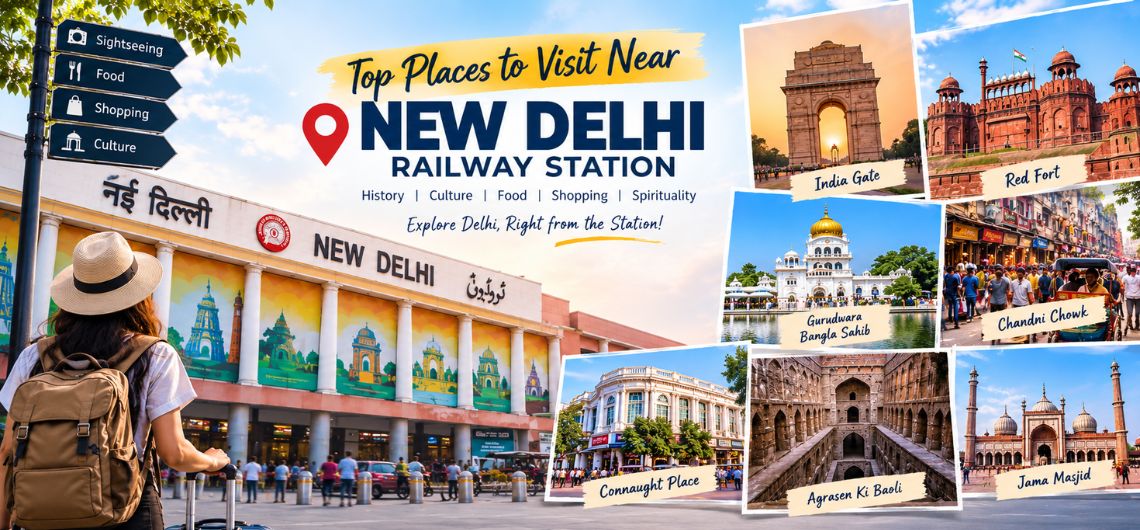
<p>New Delhi Railway Station (NDLS) sits right in the middle of the city, which makes it a genuinely useful base for sightseeing. Among the best places to visit near New Delhi Railway Station are Connaught Place, Jantar Mantar, Chandni Chowk, Jama Masjid and the Red Fort — all reachable within an afternoon. You don't need a full day here; depending on your time, you can wander a market, step inside a centuries-old monument, visit a gurudwara, or grab a meal before your next train.</p>
<!-- /wp:paragraph -->
<!-- wp:paragraph -->
<p>Maybe you've got 3–4 hours before a connecting train. Maybe you've just landed and are staying near the station for a night. Or maybe Delhi is the starting point for a longer trip to Agra or Jaipur. This guide breaks down what's nearby, how long each place takes, and how to plan around it.</p>
<!-- /wp:paragraph -->
<!-- wp:heading -->
<h2 class="wp-block-heading"><strong>Quick List of the Best Places to Visit Near New Delhi Railway Station</strong></h2>
<!-- /wp:heading -->
<!-- wp:table -->
<figure class="wp-block-table"><table class="has-fixed-layout"><tbody><tr><td><strong>Place</strong></td><td><strong>Approx. Distance</strong></td><td><strong>Ideal Visit Time</strong></td><td><strong>Best For</strong></td></tr><tr><td>Connaught Place</td><td>~1.5–2 km</td><td>1–2 hours</td><td>Shopping & food</td></tr><tr><td>Jantar Mantar</td><td>~2 km</td><td>30–60 min</td><td>History</td></tr><tr><td>Gurudwara Bangla Sahib</td><td>~2–3 km</td><td>30–60 min</td><td>Spiritual experience</td></tr><tr><td>Agrasen Ki Baoli</td><td>~2–3 km</td><td>30–45 min</td><td>Architecture & photography</td></tr><tr><td>Chandni Chowk</td><td>~3–4 km</td><td>1–2 hours</td><td>Food & culture</td></tr><tr><td>Jama Masjid</td><td>~3–4 km</td><td>45–60 min</td><td>Mughal architecture</td></tr><tr><td>Red Fort</td><td>~4 km</td><td>1–2 hours</td><td>History</td></tr><tr><td>India Gate</td><td>~4–5 km</td><td>45–60 min</td><td>Landmark & evening visit</td></tr><tr><td>Rashtrapati Bhavan</td><td>~4–5 km</td><td>30–60 min</td><td>Architecture</td></tr><tr><td>Lodhi Garden</td><td>~6–7 km</td><td>1 hour</td><td>Nature & heritage</td></tr></tbody></table></figure>
<!-- /wp:table -->
<!-- wp:paragraph -->
<p>These distances and travel times are approximate. Delhi traffic varies a lot by time of day, so it's worth checking current conditions before you set out.</p>
<!-- /wp:paragraph -->
<!-- wp:heading -->
<h2 class="wp-block-heading"><strong>1. Connaught Place</strong></h2>
<!-- /wp:heading -->
<!-- wp:paragraph -->
<p>Connaught Place, often just called "CP," is probably the easiest of all the <strong>places near New Delhi Railway Station</strong> to reach — a short auto or metro ride gets you there. Its ring of white colonnaded buildings dates to the 1930s, and the inner and outer circles are now packed with cafés, restaurants, bookstores, and local and international brands.</p>
<!-- /wp:paragraph -->
<!-- wp:paragraph -->
<p>Rajiv Chowk Metro Station sits right in the middle of CP. Janpath Market runs just off it if you want handicrafts at a more casual pace. An hour or two is enough to walk the circle and grab a bite; add more if shopping is the plan. This is one of the easiest <strong>things to do near New Delhi Railway Station</strong> when you're short on time and want food, shopping and architecture in one stop.</p>
<!-- /wp:paragraph -->
<!-- wp:heading -->
<h2 class="wp-block-heading"><strong>2. Jantar Mantar</strong></h2>
<!-- /wp:heading -->
<!-- wp:paragraph -->
<p>Jantar Mantar is an 18th-century astronomical observatory on Parliament Street, a few minutes from Connaught Place. Built in 1724 by Maharaja Jai Singh II, its large stone and masonry instruments — used to track celestial positions, time and eclipses — still look strikingly modern.</p>
<!-- /wp:paragraph -->
<!-- wp:paragraph -->
<p>Rajiv Chowk or Patel Chowk metro stations are both close by. Most visitors spend 30–60 minutes here, and mornings are quieter and cooler for photos. Ticket prices and hours change from time to time, so check current details before you go rather than relying on older figures online.</p>
<!-- /wp:paragraph -->
<!-- wp:heading -->
<h2 class="wp-block-heading"><strong>3. Gurudwara Bangla Sahib</strong></h2>
<!-- /wp:heading -->
<!-- wp:paragraph -->
<p>For travelers interested in Delhi's spiritual side, Gurudwara Bangla Sahib is a worthwhile stop. Its golden dome and the large sarovar (holy pool) in front are instantly recognizable, and the gurudwara runs a langar — a free community kitchen — serving thousands of visitors daily regardless of faith.</p>
<!-- /wp:paragraph -->
<!-- wp:paragraph -->
<p>Cover your head with a scarf (available at the entrance) and remove your shoes before entering; modest clothing is appreciated. It's about 20–30 minutes from the station by road, and 30–60 minutes is enough to look around, sit by the sarovar, and see the langar hall. Early morning or evening tends to be calmer than midday.</p>
<!-- /wp:paragraph -->
<!-- wp:heading -->
<h2 class="wp-block-heading"><strong>4. Agrasen Ki Baoli</strong></h2>
<!-- /wp:heading -->
<!-- wp:paragraph -->
<p>Tucked away near Connaught Place, Agrasen Ki Baoli is a 60-metre stepwell believed to have been built or rebuilt in the 14th century. Its rows of symmetrical stone steps descending into the earth make it one of the more photogenic, unusual stops in central Delhi, and it's often overlooked by first-time visitors.</p>
<!-- /wp:paragraph -->
<!-- wp:paragraph -->
<p>You only need 30–45 minutes here, which makes it a good fit for a short layover — it's compact, close to Connaught Place, and doesn't demand a long visit. Photographers tend to linger a bit longer for the light and symmetry.</p>
<!-- /wp:paragraph -->
<!-- wp:heading -->
<h2 class="wp-block-heading"><strong>5. Chandni Chowk</strong></h2>
<!-- /wp:heading -->
<!-- wp:paragraph -->
<p>Chandni Chowk is where you go to feel Old Delhi rather than just see it. This 17th-century market, laid out during Shah Jahan's reign, is a tangle of narrow lanes packed with spice traders, jewellers, textile shops and some of the city's most famous street food — parathas, chaat, jalebis and more.</p>
<!-- /wp:paragraph -->
<!-- wp:paragraph -->
<p>A cycle-rickshaw ride through the lanes is worth doing once. Give yourself 1–2 hours to explore, and keep an eye on your belongings — crowds can get intense, especially in the evening. It sits right next to Jama Masjid and a short walk from the Red Fort, so it pairs naturally with both.</p>
<!-- /wp:paragraph -->
<!-- wp:heading -->
<h2 class="wp-block-heading"><strong>6. Jama Masjid</strong></h2>
<!-- /wp:heading -->
<!-- wp:paragraph -->
<p>Jama Masjid, completed in 1656 under Shah Jahan, is one of India's largest mosques and a defining example of Mughal-era architecture — red sandstone and white marble, twin minarets, and a courtyard that holds thousands of worshippers. It sits at the edge of Chandni Chowk.</p>
<!-- /wp:paragraph -->
<!-- wp:paragraph -->
<p>Dress modestly; robes are available at the entrance, and non-Muslim visitors are generally welcome outside prayer times. Give it 45–60 minutes, and visit it as an active place of worship rather than purely a photo backdrop.</p>
<!-- /wp:paragraph -->
<!-- wp:heading -->
<h2 class="wp-block-heading"><strong>7. Red Fort</strong></h2>
<!-- /wp:heading -->
<!-- wp:paragraph -->
<p>If you have time for one longer stop, make it the Red Fort. Built by Shah Jahan in the 17th century and named for its massive sandstone walls, it was the seat of Mughal power for nearly 200 years and is now a <a href="https://whc.unesco.org/en/list/231/">UNESCO World Heritage Site</a>.</p>
<!-- /wp:paragraph -->
<!-- wp:paragraph -->
<p>It's about 4 km from NDLS and worth 1–2 hours for its halls, gardens and museums. Early morning means smaller crowds. Because it sits close to Chandni Chowk and Jama Masjid, many travelers combine all three into a single Old Delhi outing — and if you'd rather have this planned out for you, a guided <a href="https://www.indiabeyondtravel.com/delhi-tour/">Delhi Tour Packages</a> itinerary covers this same Old Delhi loop along with India Gate, Humayun's Tomb and other major landmarks in one day.</p>
<!-- /wp:paragraph -->
<!-- wp:heading -->
<h2 class="wp-block-heading"><strong>8. India Gate</strong></h2>
<!-- /wp:heading -->
<!-- wp:paragraph -->
<p>India Gate is one of Delhi's most photographed landmarks — a 42-metre war memorial commemorating soldiers who died in World War I, set at the end of a long stretch of lawns (Rajpath) that come alive in the evening with families, food carts and kite-flyers.</p>
<!-- /wp:paragraph -->
<!-- wp:paragraph -->
<p>It's about 4–5 km from the station, best reached by cab, auto or metro plus a short walk. Give it 45–60 minutes with other Central Delhi stops, longer if you just want to relax on the lawns at sunset.</p>
<!-- /wp:paragraph -->
<!-- wp:heading -->
<h2 class="wp-block-heading"><strong>9. Rashtrapati Bhavan</strong></h2>
<!-- /wp:heading -->
<!-- wp:paragraph -->
<p>Rashtrapati Bhavan, the official residence of the President of India, is a highlight of Lutyens' Delhi — a vast colonial-era complex blending British and Indian styles at the western end of Rajpath, near India Gate.</p>
<!-- /wp:paragraph -->
<!-- wp:paragraph -->
<p>Most visitors see it from outside, since access to the grounds and Mughal Gardens is limited and typically needs advance booking through official channels — don't plan on walking in without checking current arrangements first. 30–60 minutes is enough for photos and the surrounding Central Delhi architecture, including North and South Block.</p>
<!-- /wp:paragraph -->
<!-- wp:heading -->
<h2 class="wp-block-heading"><strong>10. National Museum</strong></h2>
<!-- /wp:heading -->
<!-- wp:paragraph -->
<p>For a deeper dive into Indian history and art, the National Museum holds an extensive collection spanning archaeology, sculpture, textiles and miniature paintings — good context before or after seeing the monuments themselves. It's a little further out but still manageable within a longer layover; budget at least 1–2 hours, or make it a quick pass-through if time is tight.</p>
<!-- /wp:paragraph -->
<!-- wp:heading -->
<h2 class="wp-block-heading"><strong>11. Paharganj</strong></h2>
<!-- /wp:heading -->
<!-- wp:paragraph -->
<p>Paharganj isn't a monument — it's a neighbourhood, and a useful one if you're staying near NDLS. Known for budget hotels, backpacker cafés and a dense main bazaar, it's within easy walking distance of the station for many travelers. The street scene is chaotic in the best and worst ways, so keep bags zipped and valuables close, especially after dark. It's a convenient, low-cost base rather than a sightseeing destination in itself.</p>
<!-- /wp:paragraph -->
<!-- wp:heading -->
<h2 class="wp-block-heading"><strong>12. Janpath Market</strong></h2>
<!-- /wp:heading -->
<!-- wp:paragraph -->
<p>Just off Connaught Place, Janpath Market is good for souvenirs, handicrafts, jewellery and budget clothing — bargaining is expected, so don't take the first price offered. Since it's essentially an extension of the CP area, the two combine easily into one outing; 30–60 minutes is usually enough unless you plan to shop seriously.</p>
<!-- /wp:paragraph -->
<!-- wp:heading -->
<h2 class="wp-block-heading"><strong>Which Places Can You Visit During a Short Layover?</strong></h2>
<!-- /wp:heading -->
<!-- wp:paragraph -->
<p><strong>With 2 hours:</strong> Visit Connaught Place and Jantar Mantar for a quick taste of central Delhi.</p>
<!-- /wp:paragraph -->
<!-- wp:paragraph -->
<p><strong>For a 3–4 hour layover:</strong> Explore Connaught Place, Jantar Mantar, Gurudwara Bangla Sahib, and Agrasen Ki Baoli.</p>
<!-- /wp:paragraph -->
<!-- wp:paragraph -->
<p><strong>A 5–6 hour stopover:</strong> You can comfortably visit Chandni Chowk, Jama Masjid, and the Red Fort.</p>
<!-- /wp:paragraph -->
<!-- wp:paragraph -->
<p><strong>With a full day available:</strong> Discover Old Delhi, including the Red Fort, Jama Masjid, Chandni Chowk, India Gate, and Central Delhi/Connaught Place.</p>
<!-- /wp:paragraph -->
<!-- wp:paragraph -->
<p>Build in a solid buffer before your train departure — Delhi traffic doesn't always cooperate with a tight schedule.</p>
<!-- /wp:paragraph -->
<!-- wp:heading -->
<h2 class="wp-block-heading"><strong>Best Places Near New Delhi Railway Station for Different Travelers</strong></h2>
<!-- /wp:heading -->
<!-- wp:table -->
<figure class="wp-block-table"><table class="has-fixed-layout"><tbody><tr><td><strong>Traveler Type</strong></td><td><strong>Recommended Places</strong></td></tr><tr><td>First-time visitor</td><td>Red Fort, India Gate, Connaught Place</td></tr><tr><td>History lovers</td><td>Red Fort, Jantar Mantar, Jama Masjid</td></tr><tr><td>Food lovers</td><td>Chandni Chowk, Connaught Place</td></tr><tr><td>Shoppers</td><td>Connaught Place, Janpath, Chandni Chowk</td></tr><tr><td>Photographers</td><td>Agrasen Ki Baoli, Red Fort, India Gate</td></tr><tr><td>Spiritual travelers</td><td>Gurudwara Bangla Sahib, Jama Masjid</td></tr><tr><td>Short layover</td><td>Connaught Place, Jantar Mantar</td></tr></tbody></table></figure>
<!-- /wp:table -->
<!-- wp:heading -->
<h2 class="wp-block-heading"><strong>How to Travel from New Delhi Railway Station to Nearby Attractions</strong></h2>
<!-- /wp:heading -->
<!-- wp:image {"id":1941,"width":"1200px","aspectRatio":"1.7142857142857142","scale":"cover","sizeSlug":"large","linkDestination":"none"} -->
<figure class="wp-block-image size-large is-resized"><img src="https://www.indiabeyondtravel.com/storage/2026/09/image-1-1024x597.jpeg" alt="Ways to travel from New Delhi Railway Station to nearby attractions by metro, auto-rickshaw, taxi and walking" class="wp-image-1941" style="aspect-ratio:1.7142857142857142;object-fit:cover;width:1200px;height:auto" title="How to Travel from New Delhi Railway Station to Nearby Attractions"/></figure>
<!-- /wp:image -->
<!-- wp:paragraph -->
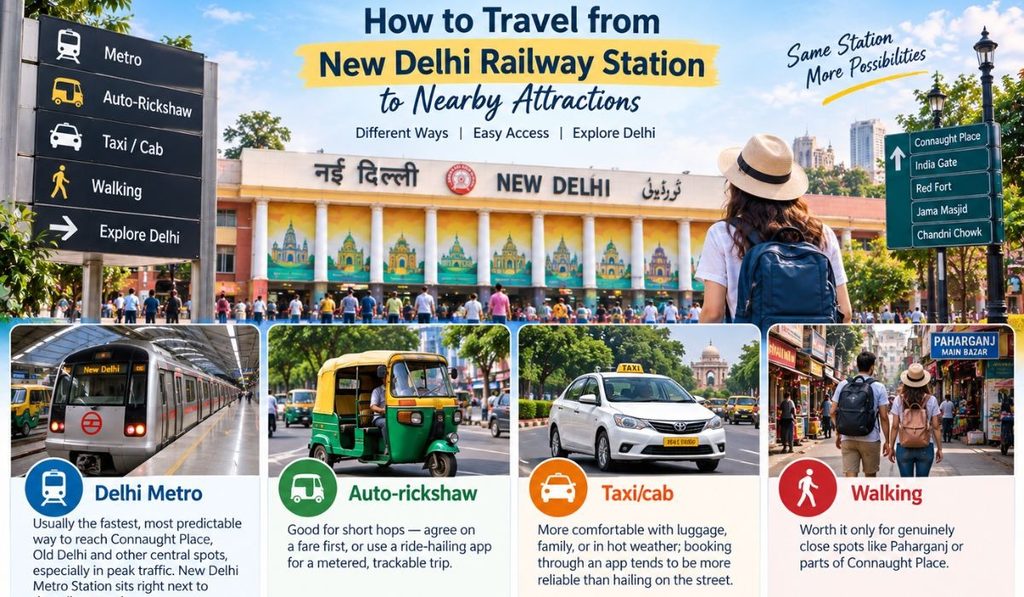
<p><strong>Delhi Metro:</strong> Usually the fastest, most predictable way to reach Connaught Place, Old Delhi and other central spots, especially in peak traffic. New Delhi Metro Station sits right next to the railway station.</p>
<!-- /wp:paragraph -->
<!-- wp:paragraph -->
<p><strong>Auto-rickshaw:</strong> Good for short hops — agree on a fare first, or use a ride-hailing app for a metered, trackable trip.</p>
<!-- /wp:paragraph -->
<!-- wp:paragraph -->
<p><strong>Taxi/cab:</strong> More comfortable with luggage, family, or in hot weather; booking through an app tends to be more reliable than hailing on the street.</p>
<!-- /wp:paragraph -->
<!-- wp:paragraph -->
<p><strong>Walking:</strong> Worth it only for genuinely close spots like Paharganj or parts of Connaught Place.</p>
<!-- /wp:paragraph -->
<!-- wp:paragraph -->
<p>Fares change often, so check current rates through your app or a pre-paid booth at the station rather than relying on a fixed number.</p>
<!-- /wp:paragraph -->
<!-- wp:heading -->
<h2 class="wp-block-heading"><strong>Tips for Sightseeing Near New Delhi Railway Station</strong></h2>
<!-- /wp:heading -->
<!-- wp:list -->
<ul class="wp-block-list"><!-- wp:list-item -->
<li>Keep luggage secure, especially in crowded areas like Chandni Chowk and Paharganj.</li>
<!-- /wp:list-item -->
<!-- wp:list-item -->
<li>Build in extra time for Delhi traffic — it rarely moves as fast as Google Maps suggests.</li>
<!-- /wp:list-item -->
<!-- wp:list-item -->
<li>Keep your train departure time firmly in mind and set a hard turnaround point.</li>
<!-- /wp:list-item -->
<!-- wp:list-item -->
<li>Use official or app-based transport rather than unmetered rides.</li>
<!-- /wp:list-item -->
<!-- wp:list-item -->
<li>Carry water, especially in summer months.</li>
<!-- /wp:list-item -->
<!-- wp:list-item -->
<li>Wear comfortable, closed footwear — you'll be walking more than you expect.</li>
<!-- /wp:list-item -->
<!-- wp:list-item -->
<li>Check monument opening days, closures and current ticket prices before heading out.</li>
<!-- /wp:list-item -->
<!-- wp:list-item -->
<li>Dress modestly at religious sites like Jama Masjid and Gurudwara Bangla Sahib.</li>
<!-- /wp:list-item -->
<!-- wp:list-item -->
<li>Don't try to pack too many attractions into a short layover — two or three done well beats five done in a rush.</li>
<!-- /wp:list-item -->
<!-- wp:list-item -->
<li>Always leave buffer time to get back to the station.</li>
<!-- /wp:list-item --></ul>
<!-- /wp:list -->
<!-- wp:heading -->
<h2 class="wp-block-heading"><strong>Suggested Delhi Sightseeing Itineraries from New Delhi Railway Station</strong></h2>
<!-- /wp:heading -->
<!-- wp:paragraph -->
<p><strong>3-Hour Itinerary:</strong> New Delhi Railway Station → Connaught Place → Jantar Mantar → Return to station</p>
<!-- /wp:paragraph -->
<!-- wp:paragraph -->
<p><strong>5-Hour Itinerary:</strong> New Delhi Railway Station → Chandni Chowk → Jama Masjid → Red Fort → Return to station</p>
<!-- /wp:paragraph -->
<!-- wp:paragraph -->
<p><strong>Full-Day Delhi Itinerary:</strong> New Delhi Railway Station → Old Delhi (Red Fort, Jama Masjid, Chandni Chowk) → India Gate → Connaught Place → Return</p>
<!-- /wp:paragraph -->
<!-- wp:paragraph -->
<p>Actual travel time depends on traffic and crowds — treat these as a starting framework, not a fixed schedule. If you'd rather have this planned and guided for you, an <a href="https://www.indiabeyondtravel.com/tours/old-new-delhi-day-tour/">Old & New Delhi Day Tour</a> covers this same Old Delhi and New Delhi combination in a single guided day. For travelers who have an extra night in the city and want a more relaxed pace instead of packing everything into one day, a <a href="https://www.indiabeyondtravel.com/tours/delhi-overnight-tour-by-car/">Delhi Overnight Tour by Car</a> spreads the sightseeing, markets and food across two days with private transport.</p>
<!-- /wp:paragraph -->
<!-- wp:heading -->
<h2 class="wp-block-heading"><strong>Frequently Asked Questions</strong></h2>
<!-- /wp:heading -->
<!-- wp:paragraph -->
<p><strong>What are the best places to visit near New Delhi Railway Station?</strong> </p>
<!-- /wp:paragraph -->
<!-- wp:paragraph -->
<p>Connaught Place, Jantar Mantar, Gurudwara Bangla Sahib, Chandni Chowk, Jama Masjid and the Red Fort are among the most accessible and worthwhile options.</p>
<!-- /wp:paragraph -->
<!-- wp:paragraph -->
<p><strong>How far is Connaught Place from New Delhi Railway Station?</strong> </p>
<!-- /wp:paragraph -->
<!-- wp:paragraph -->
<p>Roughly 1.5–2 km, making it one of the quickest stops to reach by metro, auto or a short walk.</p>
<!-- /wp:paragraph -->
<!-- wp:paragraph -->
<p><strong>Which tourist places are closest to New Delhi Railway Station?</strong> </p>
<!-- /wp:paragraph -->
<!-- wp:paragraph -->
<p>Connaught Place, Jantar Mantar, Gurudwara Bangla Sahib and Agrasen Ki Baoli are all within about 2–3 km.</p>
<!-- /wp:paragraph -->
<!-- wp:paragraph -->
<p><strong>Can I visit Red Fort from New Delhi Railway Station?</strong> </p>
<!-- /wp:paragraph -->
<!-- wp:paragraph -->
<p>Yes — it's about 4 km away and typically takes 1–2 hours to explore properly.</p>
<!-- /wp:paragraph -->
<!-- wp:paragraph -->
<p><strong>What can I visit near New Delhi Railway Station in 3 hours?</strong> </p>
<!-- /wp:paragraph -->
<!-- wp:paragraph -->
<p>Connaught Place and Jantar Mantar together fit comfortably into a 3-hour window.</p>
<!-- /wp:paragraph -->
<!-- wp:paragraph -->
<p><strong>Is Chandni Chowk near New Delhi Railway Station?</strong> </p>
<!-- /wp:paragraph -->
<!-- wp:paragraph -->
<p>Yes, it's roughly 3–4 km away and easily paired with Jama Masjid and the Red Fort.</p>
<!-- /wp:paragraph -->
<!-- wp:paragraph -->
<p><strong>How can I reach India Gate from New Delhi Railway Station?</strong> </p>
<!-- /wp:paragraph -->
<!-- wp:paragraph -->
<p>By cab, auto-rickshaw, or metro combined with a short walk; it's about 4–5 km from the station.</p>
<!-- /wp:paragraph -->
<!-- wp:paragraph -->
<p><strong>Can I visit the Taj Mahal from New Delhi Railway Station in one day?</strong> </p>
<!-- /wp:paragraph -->
<!-- wp:paragraph -->
<p>Yes, with a full day available, though same-day train tours to Agra depart from Hazrat Nizamuddin Railway Station rather than NDLS, so plan for that transfer.</p>
<!-- /wp:paragraph -->
<!-- wp:paragraph -->
<p><strong>Is New Delhi Railway Station a good starting point for Delhi sightseeing?</strong> </p>
<!-- /wp:paragraph -->
<!-- wp:paragraph -->
<p>Yes — its central location puts most of Old and Central Delhi's major attractions within a short ride.</p>
<!-- /wp:paragraph -->
<!-- wp:heading -->
<h2 class="wp-block-heading"><strong>Conclusion</strong></h2>
<!-- /wp:heading -->
<!-- wp:paragraph -->
<p>New Delhi Railway Station's central location makes it a genuinely convenient base for exploring Delhi, whatever time you're working with. A short layover suits Connaught Place or Jantar Mantar; half a day opens up Old Delhi and the Red Fort; and a full day lets you add India Gate and Central Delhi to the mix.</p>
<!-- /wp:paragraph -->
<!-- wp:paragraph -->
<p>Whether you have a few hours or an entire day, planning your route around New Delhi Railway Station helps you see more of Delhi without rushing.</p>
<!-- /wp:paragraph -->
<!-- wp:paragraph -->
<p></p>
<!-- /wp:paragraph -->
New Delhi Railway Station (NDLS) sits right in the middle of the city, which makes it a genuinely useful base for sightseeing. Among the best places to visit near New Delhi Railway Station are Connaught Place, Jantar Mantar, Chandni Chowk, Jama Masjid and the Red Fort — all reachable within an afternoon. You don’t need a full day here; depending on your time, you can wander a market, step inside a centuries-old monument, visit a gurudwara, or grab a meal before your next train.
Maybe you’ve got 3–4 hours before a connecting train. Maybe you’ve just landed and are staying near the station for a night. Or maybe Delhi is the starting point for a longer trip to Agra or Jaipur. This guide breaks down what’s nearby, how long each place takes, and how to plan around it.
Quick List of the Best Places to Visit Near New Delhi Railway Station
Place
Approx. Distance
Ideal Visit Time
Best For
Connaught Place
~1.5–2 km
1–2 hours
Shopping & food
Jantar Mantar
~2 km
30–60 min
History
Gurudwara Bangla Sahib
~2–3 km
30–60 min
Spiritual experience
Agrasen Ki Baoli
~2–3 km
30–45 min
Architecture & photography
Chandni Chowk
~3–4 km
1–2 hours
Food & culture
Jama Masjid
~3–4 km
45–60 min
Mughal architecture
Red Fort
~4 km
1–2 hours
History
India Gate
~4–5 km
45–60 min
Landmark & evening visit
Rashtrapati Bhavan
~4–5 km
30–60 min
Architecture
Lodhi Garden
~6–7 km
1 hour
Nature & heritage
These distances and travel times are approximate. Delhi traffic varies a lot by time of day, so it’s worth checking current conditions before you set out.
1. Connaught Place
Connaught Place, often just called “CP,” is probably the easiest of all the places near New Delhi Railway Station to reach — a short auto or metro ride gets you there. Its ring of white colonnaded buildings dates to the 1930s, and the inner and outer circles are now packed with cafés, restaurants, bookstores, and local and international brands.
Rajiv Chowk Metro Station sits right in the middle of CP. Janpath Market runs just off it if you want handicrafts at a more casual pace. An hour or two is enough to walk the circle and grab a bite; add more if shopping is the plan. This is one of the easiest things to do near New Delhi Railway Station when you’re short on time and want food, shopping and architecture in one stop.
2. Jantar Mantar
Jantar Mantar is an 18th-century astronomical observatory on Parliament Street, a few minutes from Connaught Place. Built in 1724 by Maharaja Jai Singh II, its large stone and masonry instruments — used to track celestial positions, time and eclipses — still look strikingly modern.
Rajiv Chowk or Patel Chowk metro stations are both close by. Most visitors spend 30–60 minutes here, and mornings are quieter and cooler for photos. Ticket prices and hours change from time to time, so check current details before you go rather than relying on older figures online.
3. Gurudwara Bangla Sahib
For travelers interested in Delhi’s spiritual side, Gurudwara Bangla Sahib is a worthwhile stop. Its golden dome and the large sarovar (holy pool) in front are instantly recognizable, and the gurudwara runs a langar — a free community kitchen — serving thousands of visitors daily regardless of faith.
Cover your head with a scarf (available at the entrance) and remove your shoes before entering; modest clothing is appreciated. It’s about 20–30 minutes from the station by road, and 30–60 minutes is enough to look around, sit by the sarovar, and see the langar hall. Early morning or evening tends to be calmer than midday.
4. Agrasen Ki Baoli
Tucked away near Connaught Place, Agrasen Ki Baoli is a 60-metre stepwell believed to have been built or rebuilt in the 14th century. Its rows of symmetrical stone steps descending into the earth make it one of the more photogenic, unusual stops in central Delhi, and it’s often overlooked by first-time visitors.
You only need 30–45 minutes here, which makes it a good fit for a short layover — it’s compact, close to Connaught Place, and doesn’t demand a long visit. Photographers tend to linger a bit longer for the light and symmetry.
5. Chandni Chowk
Chandni Chowk is where you go to feel Old Delhi rather than just see it. This 17th-century market, laid out during Shah Jahan’s reign, is a tangle of narrow lanes packed with spice traders, jewellers, textile shops and some of the city’s most famous street food — parathas, chaat, jalebis and more.
A cycle-rickshaw ride through the lanes is worth doing once. Give yourself 1–2 hours to explore, and keep an eye on your belongings — crowds can get intense, especially in the evening. It sits right next to Jama Masjid and a short walk from the Red Fort, so it pairs naturally with both.
6. Jama Masjid
Jama Masjid, completed in 1656 under Shah Jahan, is one of India’s largest mosques and a defining example of Mughal-era architecture — red sandstone and white marble, twin minarets, and a courtyard that holds thousands of worshippers. It sits at the edge of Chandni Chowk.
Dress modestly; robes are available at the entrance, and non-Muslim visitors are generally welcome outside prayer times. Give it 45–60 minutes, and visit it as an active place of worship rather than purely a photo backdrop.
7. Red Fort
If you have time for one longer stop, make it the Red Fort. Built by Shah Jahan in the 17th century and named for its massive sandstone walls, it was the seat of Mughal power for nearly 200 years and is now a UNESCO World Heritage Site.
It’s about 4 km from NDLS and worth 1–2 hours for its halls, gardens and museums. Early morning means smaller crowds. Because it sits close to Chandni Chowk and Jama Masjid, many travelers combine all three into a single Old Delhi outing — and if you’d rather have this planned out for you, a guided Delhi Tour Packages itinerary covers this same Old Delhi loop along with India Gate, Humayun’s Tomb and other major landmarks in one day.
8. India Gate
India Gate is one of Delhi’s most photographed landmarks — a 42-metre war memorial commemorating soldiers who died in World War I, set at the end of a long stretch of lawns (Rajpath) that come alive in the evening with families, food carts and kite-flyers.
It’s about 4–5 km from the station, best reached by cab, auto or metro plus a short walk. Give it 45–60 minutes with other Central Delhi stops, longer if you just want to relax on the lawns at sunset.
9. Rashtrapati Bhavan
Rashtrapati Bhavan, the official residence of the President of India, is a highlight of Lutyens’ Delhi — a vast colonial-era complex blending British and Indian styles at the western end of Rajpath, near India Gate.
Most visitors see it from outside, since access to the grounds and Mughal Gardens is limited and typically needs advance booking through official channels — don’t plan on walking in without checking current arrangements first. 30–60 minutes is enough for photos and the surrounding Central Delhi architecture, including North and South Block.
10. National Museum
For a deeper dive into Indian history and art, the National Museum holds an extensive collection spanning archaeology, sculpture, textiles and miniature paintings — good context before or after seeing the monuments themselves. It’s a little further out but still manageable within a longer layover; budget at least 1–2 hours, or make it a quick pass-through if time is tight.
11. Paharganj
Paharganj isn’t a monument — it’s a neighbourhood, and a useful one if you’re staying near NDLS. Known for budget hotels, backpacker cafés and a dense main bazaar, it’s within easy walking distance of the station for many travelers. The street scene is chaotic in the best and worst ways, so keep bags zipped and valuables close, especially after dark. It’s a convenient, low-cost base rather than a sightseeing destination in itself.
12. Janpath Market
Just off Connaught Place, Janpath Market is good for souvenirs, handicrafts, jewellery and budget clothing — bargaining is expected, so don’t take the first price offered. Since it’s essentially an extension of the CP area, the two combine easily into one outing; 30–60 minutes is usually enough unless you plan to shop seriously.
Which Places Can You Visit During a Short Layover?
With 2 hours: Visit Connaught Place and Jantar Mantar for a quick taste of central Delhi.
For a 3–4 hour layover: Explore Connaught Place, Jantar Mantar, Gurudwara Bangla Sahib, and Agrasen Ki Baoli.
A 5–6 hour stopover: You can comfortably visit Chandni Chowk, Jama Masjid, and the Red Fort.
With a full day available: Discover Old Delhi, including the Red Fort, Jama Masjid, Chandni Chowk, India Gate, and Central Delhi/Connaught Place.
Build in a solid buffer before your train departure — Delhi traffic doesn’t always cooperate with a tight schedule.
Best Places Near New Delhi Railway Station for Different Travelers
Traveler Type
Recommended Places
First-time visitor
Red Fort, India Gate, Connaught Place
History lovers
Red Fort, Jantar Mantar, Jama Masjid
Food lovers
Chandni Chowk, Connaught Place
Shoppers
Connaught Place, Janpath, Chandni Chowk
Photographers
Agrasen Ki Baoli, Red Fort, India Gate
Spiritual travelers
Gurudwara Bangla Sahib, Jama Masjid
Short layover
Connaught Place, Jantar Mantar
How to Travel from New Delhi Railway Station to Nearby Attractions
Delhi Metro: Usually the fastest, most predictable way to reach Connaught Place, Old Delhi and other central spots, especially in peak traffic. New Delhi Metro Station sits right next to the railway station.
Auto-rickshaw: Good for short hops — agree on a fare first, or use a ride-hailing app for a metered, trackable trip.
Taxi/cab: More comfortable with luggage, family, or in hot weather; booking through an app tends to be more reliable than hailing on the street.
Walking: Worth it only for genuinely close spots like Paharganj or parts of Connaught Place.
Fares change often, so check current rates through your app or a pre-paid booth at the station rather than relying on a fixed number.
Tips for Sightseeing Near New Delhi Railway Station
Keep luggage secure, especially in crowded areas like Chandni Chowk and Paharganj.
Build in extra time for Delhi traffic — it rarely moves as fast as Google Maps suggests.
Keep your train departure time firmly in mind and set a hard turnaround point.
Use official or app-based transport rather than unmetered rides.
Carry water, especially in summer months.
Wear comfortable, closed footwear — you’ll be walking more than you expect.
Check monument opening days, closures and current ticket prices before heading out.
Dress modestly at religious sites like Jama Masjid and Gurudwara Bangla Sahib.
Don’t try to pack too many attractions into a short layover — two or three done well beats five done in a rush.
Always leave buffer time to get back to the station.
Suggested Delhi Sightseeing Itineraries from New Delhi Railway Station
3-Hour Itinerary: New Delhi Railway Station → Connaught Place → Jantar Mantar → Return to station
5-Hour Itinerary: New Delhi Railway Station → Chandni Chowk → Jama Masjid → Red Fort → Return to station
Full-Day Delhi Itinerary: New Delhi Railway Station → Old Delhi (Red Fort, Jama Masjid, Chandni Chowk) → India Gate → Connaught Place → Return
Actual travel time depends on traffic and crowds — treat these as a starting framework, not a fixed schedule. If you’d rather have this planned and guided for you, an Old & New Delhi Day Tour covers this same Old Delhi and New Delhi combination in a single guided day. For travelers who have an extra night in the city and want a more relaxed pace instead of packing everything into one day, a Delhi Overnight Tour by Car spreads the sightseeing, markets and food across two days with private transport.
Frequently Asked Questions
What are the best places to visit near New Delhi Railway Station?
Connaught Place, Jantar Mantar, Gurudwara Bangla Sahib, Chandni Chowk, Jama Masjid and the Red Fort are among the most accessible and worthwhile options.
How far is Connaught Place from New Delhi Railway Station?
Roughly 1.5–2 km, making it one of the quickest stops to reach by metro, auto or a short walk.
Which tourist places are closest to New Delhi Railway Station?
Connaught Place, Jantar Mantar, Gurudwara Bangla Sahib and Agrasen Ki Baoli are all within about 2–3 km.
Can I visit Red Fort from New Delhi Railway Station?
Yes — it’s about 4 km away and typically takes 1–2 hours to explore properly.
What can I visit near New Delhi Railway Station in 3 hours?
Connaught Place and Jantar Mantar together fit comfortably into a 3-hour window.
Is Chandni Chowk near New Delhi Railway Station?
Yes, it’s roughly 3–4 km away and easily paired with Jama Masjid and the Red Fort.
How can I reach India Gate from New Delhi Railway Station?
By cab, auto-rickshaw, or metro combined with a short walk; it’s about 4–5 km from the station.
Can I visit the Taj Mahal from New Delhi Railway Station in one day?
Yes, with a full day available, though same-day train tours to Agra depart from Hazrat Nizamuddin Railway Station rather than NDLS, so plan for that transfer.
Is New Delhi Railway Station a good starting point for Delhi sightseeing?
Yes — its central location puts most of Old and Central Delhi’s major attractions within a short ride.
Conclusion
New Delhi Railway Station’s central location makes it a genuinely convenient base for exploring Delhi, whatever time you’re working with. A short layover suits Connaught Place or Jantar Mantar; half a day opens up Old Delhi and the Red Fort; and a full day lets you add India Gate and Central Delhi to the mix.
Whether you have a few hours or an entire day, planning your route around New Delhi Railway Station helps you see more of Delhi without rushing.
<!-- wp:paragraph -->
<p>If you're planning your first trip across the subcontinent, there's a good chance every itinerary you've looked at begins in one place: Delhi. And that's no accident. With <strong>India tour packages from Delhi</strong>, travellers get the shortest possible distance between landing and sightseeing — the capital sits at the crossroads of North India's most famous destinations, backed by an international airport, a dense railway network, and highways that fan out toward Agra, Jaipur, and beyond. Whether you have three days or three weeks, Delhi is where a well-planned India trip usually starts, and for good reason.</p>
<!-- /wp:paragraph -->
<!-- wp:paragraph -->
<p>This guide walks through the most popular multi-day itineraries departing from the capital, how to pick the right one for your travel style, and what to know before you book.</p>
<!-- /wp:paragraph -->
<!-- wp:heading -->
<h2 class="wp-block-heading"><strong>Why Start Your India Tour from Delhi?</strong></h2>
<!-- /wp:heading -->
<!-- wp:paragraph -->
<p>Delhi isn't just convenient — it's genuinely the smartest launch pad for exploring the country.</p>
<!-- /wp:paragraph -->
<!-- wp:list -->
<ul class="wp-block-list"><!-- wp:list-item -->
<li><strong>International airport:</strong> Indira Gandhi International Airport connects Delhi to almost every major global hub, so most travellers land here regardless of their final destination.</li>
<!-- /wp:list-item -->
<!-- wp:list-item -->
<li><strong>Easy transportation:</strong> Superfast trains, well-maintained national highways, and private car services make onward travel to Agra, Jaipur, and Rajasthan straightforward and comfortable.</li>
<!-- /wp:list-item -->
<!-- wp:list-item -->
<li><strong>Rich history on day one:</strong> Before heading anywhere else, Delhi itself offers Mughal-era forts, colonial-era boulevards, and centuries-old markets worth a day or two of exploring.</li>
<!-- /wp:list-item -->
<!-- wp:list-item -->
<li><strong>Flexible itineraries:</strong> Because so many tours originate here, it's easy to mix and match — a short Taj Mahal trip, a longer Rajasthan circuit, or a wildlife detour can all be built around a Delhi start.</li>
<!-- /wp:list-item -->
<!-- wp:list-item -->
<li><strong>Gateway to India's icons:</strong> The Taj Mahal, the Pink City of Jaipur, the forts of Rajasthan, and the tiger reserves of Ranthambore are all within a comfortable drive or train ride.</li>
<!-- /wp:list-item --></ul>
<!-- /wp:list -->
<!-- wp:paragraph -->
<p>In short, starting from Delhi cuts down on wasted travel time and lets you spend more of your trip actually seeing India rather than getting to it.</p>
<!-- /wp:paragraph -->
<!-- wp:heading -->
<h2 class="wp-block-heading"><strong>Best India Tour Packages Starting from Delhi</strong></h2>
<!-- /wp:heading -->
<!-- wp:paragraph -->
<p>North India's tour circuit is built around a handful of core routes, each of which can be shortened, extended, or combined depending on how much time you have. Here's a closer look at the most popular options.</p>
<!-- /wp:paragraph -->
<!-- wp:heading {"level":3} -->
<h3 class="wp-block-heading"><strong>Golden Triangle Tours</strong></h3>
<!-- /wp:heading -->
<!-- wp:paragraph -->
<p>The Golden Triangle — Delhi, Agra, and Jaipur — is India's most travelled circuit, and for first-timers, it's usually the natural starting point. It packs the Taj Mahal, the Pink City's forts and palaces, and the capital's own monuments into a single, well-paced loop.</p>
<!-- /wp:paragraph -->
<!-- wp:list -->
<ul class="wp-block-list"><!-- wp:list-item -->
<li><strong>3 Days Golden Triangle Tour</strong> — a compact option for travellers with limited time who still want to see all three cities.</li>
<!-- /wp:list-item -->
<!-- wp:list-item -->
<li><strong>4 Days Golden Triangle Tour</strong> — adds breathing room for extra sightseeing without stretching the trip too long.</li>
<!-- /wp:list-item -->
<!-- wp:list-item -->
<li><strong>5 Days Golden Triangle Tour</strong> — a more relaxed pace, better suited to travellers who prefer fewer early starts and long drives.</li>
<!-- /wp:list-item -->
<!-- wp:list-item -->
<li><strong>6 Days Golden Triangle Tour</strong> — the most immersive version of the classic route, with time for markets, food, and lesser-known sights alongside the headline monuments.</li>
<!-- /wp:list-item --></ul>
<!-- /wp:list -->
<!-- wp:paragraph -->
<p>For those who want to go further, the same route can be extended into longer journeys — combined with Ranthambore's tiger safaris, the spiritual ghats of Varanasi, the desert forts of Jodhpur and Jaisalmer, the lakes of Udaipur, the Golden Temple in Amritsar, the UNESCO temples of Khajuraho, or the sacred confluence at Prayagraj. Full details on all these itineraries are available on the <a href="https://www.indiabeyondtravel.com/golden-triangle-tour/">Golden Triangle Tour Packages</a> page.</p>
<!-- /wp:paragraph -->
<!-- wp:heading {"level":3} -->
<h3 class="wp-block-heading"><strong>Taj Mahal Tours</strong></h3>
<!-- /wp:heading -->
<!-- wp:paragraph -->
<p>For travellers who only have a day or two to spare, a dedicated Taj Mahal trip is often the most practical choice — and it's consistently one of the most-booked <strong>India tour packages from Delhi</strong>.</p>
<!-- /wp:paragraph -->
<!-- wp:list -->
<ul class="wp-block-list"><!-- wp:list-item -->
<li><strong>Taj Mahal Tour by Luxury Car</strong> — private, comfortable, and unhurried, ideal for those who want a premium experience.</li>
<!-- /wp:list-item -->
<!-- wp:list-item -->
<li><strong>Sunrise Taj Mahal Tour</strong> — timed to catch the monument at its most photogenic, before the crowds and heat set in.</li>
<!-- /wp:list-item -->
<!-- wp:list-item -->
<li><strong>Taj Mahal Tour by Superfast Train</strong> — a quicker, scenic alternative to driving, popular with travellers short on time.</li>
<!-- /wp:list-item -->
<!-- wp:list-item -->
<li><strong>Taj Mahal Tour from Delhi by Car</strong> — a straightforward same-day option covering Agra's highlights with private transport.</li>
<!-- /wp:list-item --></ul>
<!-- /wp:list -->
<!-- wp:paragraph -->
<p>Each of these focuses on convenience: skip-the-line entry, knowledgeable guides, and a same-day return to Delhi, so you don't need to rearrange the rest of your trip around it. More options are listed under <a href="https://www.indiabeyondtravel.com/taj-mahal-tour/">Taj Mahal Tour Packages</a>.</p>
<!-- /wp:paragraph -->
<!-- wp:heading {"level":3} -->
<h3 class="wp-block-heading"><strong>Jaipur Tours</strong></h3>
<!-- /wp:heading -->
<!-- wp:paragraph -->
<p>Jaipur, the Pink City, is Rajasthan's most accessible introduction — close enough to Delhi for a day trip, yet rich enough in history to justify a longer stay.</p>
<!-- /wp:paragraph -->
<!-- wp:list -->
<ul class="wp-block-list"><!-- wp:list-item -->
<li><strong>Jaipur Tour by Train</strong> — a comfortable rail journey followed by a full day of sightseeing.</li>
<!-- /wp:list-item -->
<!-- wp:list-item -->
<li><strong>Full Day Jaipur Heritage Tour</strong> — a deeper dive into the city's landmarks with a private guide.</li>
<!-- /wp:list-item --></ul>
<!-- /wp:list -->
<!-- wp:paragraph -->
<p>Highlights typically include the hilltop Amber Fort, the ornate City Palace, the iconic pink facade of Hawa Mahal, and Jaipur's bustling local markets, known for textiles, jewellery, and handicrafts. Browse the full range on the <a href="https://www.indiabeyondtravel.com/jaipur-tour/">Jaipur Tour Packages</a> page.</p>
<!-- /wp:paragraph -->
<!-- wp:heading {"level":3} -->
<h3 class="wp-block-heading"><strong>Delhi Tours</strong></h3>
<!-- /wp:heading -->
<!-- wp:paragraph -->
<p>It's easy to treat Delhi as just a transit point, but the city rewards a proper visit before you move on.</p>
<!-- /wp:paragraph -->
<!-- wp:list -->
<ul class="wp-block-list"><!-- wp:list-item -->
<li><strong>Old & New Delhi Tour</strong> — covers both the Mughal-era lanes of Old Delhi and the colonial-planned avenues of New Delhi in a single day.</li>
<!-- /wp:list-item -->
<!-- wp:list-item -->
<li><strong>Delhi Overnight Tour</strong> — for travellers arriving late or wanting a more relaxed, two-day introduction to the capital.</li>
<!-- /wp:list-item --></ul>
<!-- /wp:list -->
<!-- wp:paragraph -->
<p>Spending time in Delhi first also helps with acclimatising — to the pace, the traffic, and the sheer scale of India — before heading into smaller cities. Full itineraries are available under <a href="https://www.indiabeyondtravel.com/delhi-tour/">Delhi Tour Packages.</a></p>
<!-- /wp:paragraph -->
<!-- wp:heading {"level":3} -->
<h3 class="wp-block-heading"><strong>Wildlife Tours</strong></h3>
<!-- /wp:heading -->
<!-- wp:paragraph -->
<p>For travellers who want more than monuments, a wildlife detour adds a completely different dimension to a North India trip.</p>
<!-- /wp:paragraph -->
<!-- wp:paragraph -->
<p>The <strong>Delhi to Ranthambore Tiger Safari Expedition</strong> takes travellers to one of India's best-known tiger reserves, with multiple safari drives in search of the Royal Bengal Tiger alongside leopards, deer, and a wide variety of birdlife. The best safari season generally runs from October to June, with the warmer months between March and June often producing the strongest tiger sightings as animals gather near water sources. Details are available on the <a href="https://www.indiabeyondtravel.com/wildlife-tours/">Wildlife Tour Packages</a> page.</p>
<!-- /wp:paragraph -->
<!-- wp:heading {"level":3} -->
<h3 class="wp-block-heading"><strong>Extended India Tours</strong></h3>
<!-- /wp:heading -->
<!-- wp:paragraph -->
<p>For travellers with two weeks or more, the Golden Triangle can be extended into a much larger circuit:</p>
<!-- /wp:paragraph -->
<!-- wp:image {"id":1900,"sizeSlug":"large","linkDestination":"none"} -->
<figure class="wp-block-image size-large"><img src="https://www.indiabeyondtravel.com/storage/2026/07/image-3-1024x597.jpeg" alt="Collage of India's top tourist destinations including the Taj Mahal, Varanasi Ghats, Golden Temple, Jodhpur, Udaipur, Jaisalmer Desert, Khajuraho Temples, Gwalior Fort, and Jaisalmer Fort." class="wp-image-1900" title="Best India Tour Destinations – Complete India Travel Guide"/></figure>
<!-- /wp:image -->
<!-- wp:list -->
<ul class="wp-block-list"><!-- wp:list-item -->
<li><strong>Golden Triangle with Prayagraj</strong> — combines the classic route with one of India's holiest pilgrimage cities.</li>
<!-- /wp:list-item -->
<!-- wp:list-item -->
<li><strong>Golden Triangle with Amritsar</strong> — pairs Delhi, Agra, and Jaipur with the spiritual calm of the Golden Temple and the Wagah Border ceremony.</li>
<!-- /wp:list-item -->
<!-- wp:list-item -->
<li><strong>Golden Triangle with Jodhpur & Udaipur</strong> — adds Rajasthan's blue city and its romantic lake palaces.</li>
<!-- /wp:list-item -->
<!-- wp:list-item -->
<li><strong>Golden Triangle with Jodhpur & Jaisalmer</strong> — extends into the Thar Desert, with forts, camel safaris, and golden dunes.</li>
<!-- /wp:list-item -->
<!-- wp:list-item -->
<li><strong>Golden Triangle with Gwalior, Orchha, Khajuraho & Tiger Safari</strong> — blends heritage architecture with a Ranthambore safari for a genuinely varied trip.</li>
<!-- /wp:list-item -->
<!-- wp:list-item -->
<li><strong>Royal Rajasthan Tour</strong> — an 18-day, in-depth journey through Rajasthan's palaces, forts, and desert landscapes for travellers who want to see the state in real depth.</li>
<!-- /wp:list-item --></ul>
<!-- /wp:list -->
<!-- wp:paragraph -->
<p>These longer tours suit travellers who've already done a shorter India trip, or first-timers who simply have the time and want to avoid returning too soon.</p>
<!-- /wp:paragraph -->
<!-- wp:heading -->
<h2 class="wp-block-heading"><strong>How to Choose the Right India Tour Package</strong></h2>
<!-- /wp:heading -->
<!-- wp:paragraph -->
<p>With so many options, the right choice usually comes down to a few practical factors:</p>
<!-- /wp:paragraph -->
<!-- wp:list -->
<ul class="wp-block-list"><!-- wp:list-item -->
<li><strong>Budget:</strong> Shorter Golden Triangle tours and same-day trips are more economical, while extended multi-city itineraries and luxury car tours cost more but cover far more ground.</li>
<!-- /wp:list-item -->
<!-- wp:list-item -->
<li><strong>Duration:</strong> Have 3–4 days? Stick to the classic Golden Triangle. Have 10 days or more? Consider an extended tour with Rajasthan or wildlife add-ons.</li>
<!-- /wp:list-item -->
<!-- wp:list-item -->
<li><strong>Family vs. couples:</strong> Family itineraries benefit from a slightly slower pace with fewer early starts, while couples often prefer luxury car options or romantic destinations like Udaipur.</li>
<!-- /wp:list-item -->
<!-- wp:list-item -->
<li><strong>Solo travellers:</strong> Group-friendly, well-structured tours like the standard Golden Triangle packages tend to work best for solo travellers new to India.</li>
<!-- /wp:list-item -->
<!-- wp:list-item -->
<li><strong>First-time visitors:</strong> The 4 or 5-day Golden Triangle Tour is generally the easiest introduction — enough time to see the essentials without feeling rushed.</li>
<!-- /wp:list-item -->
<!-- wp:list-item -->
<li><strong>Luxury vs. budget travel:</strong> Decide early whether comfort (private luxury cars, higher-end hotels) or value is the priority, since it shapes almost every other choice.</li>
<!-- /wp:list-item -->
<!-- wp:list-item -->
<li><strong>Best season:</strong> Aligning your trip with the right months (more on this below) makes a bigger difference to comfort than almost anything else.</li>
<!-- /wp:list-item --></ul>
<!-- /wp:list -->
<!-- wp:heading -->
<h2 class="wp-block-heading"><strong>Best Time to Travel Around India from Delhi</strong></h2>
<!-- /wp:heading -->
<!-- wp:list -->
<ul class="wp-block-list"><!-- wp:list-item -->
<li><strong>October to March:</strong> The most popular window, with cool, dry weather that's ideal for sightseeing in Delhi, Agra, Jaipur, and Rajasthan.</li>
<!-- /wp:list-item -->
<!-- wp:list-item -->
<li><strong>Summer (April–June):</strong> Hot and dry across North India, though this period can actually improve wildlife sightings in Ranthambore.</li>
<!-- /wp:list-item -->
<!-- wp:list-item -->
<li><strong>Monsoon (July–September):</strong> Fewer crowds and lush landscapes, but heavy rain can disrupt outdoor sightseeing and road travel.</li>
<!-- /wp:list-item -->
<!-- wp:list-item -->
<li><strong>Festival season:</strong> Diwali (October/November) and Holi (March) bring India's culture to life, though these periods also see higher demand for hotels and transport, so booking ahead matters.</li>
<!-- /wp:list-item --></ul>
<!-- /wp:list -->
<!-- wp:heading -->
<h2 class="wp-block-heading"><strong>Travel Tips Before Booking</strong></h2>
<!-- /wp:heading -->
<!-- wp:list -->
<ul class="wp-block-list"><!-- wp:list-item -->
<li><strong>Clothing:</strong> Pack light, breathable layers for the day and something warmer for winter mornings and evenings, especially between November and February.</li>
<!-- /wp:list-item -->
<!-- wp:list-item -->
<li><strong>Cash:</strong> Carry some local currency for markets, small vendors, and tips, even though most hotels and larger shops accept cards.</li>
<!-- /wp:list-item -->
<!-- wp:list-item -->
<li><strong>SIM card:</strong> A local SIM or eSIM makes navigation, translation apps, and staying in touch with your guide far easier.</li>
<!-- /wp:list-item -->
<!-- wp:list-item -->
<li><strong>Local transport:</strong> Private cars are the most convenient way to move between cities, while trains are a comfortable, scenic alternative for shorter hops like Delhi–Agra or Delhi–Jaipur.</li>
<!-- /wp:list-item -->
<!-- wp:list-item -->
<li><strong>Tour guide:</strong> A knowledgeable local guide adds real context to sites like the Taj Mahal or Amber Fort — details you'd likely miss travelling independently.</li>
<!-- /wp:list-item -->
<!-- wp:list-item -->
<li><strong>Photography:</strong> Early morning visits (especially at the Taj Mahal) offer the best light and smaller crowds.</li>
<!-- /wp:list-item -->
<!-- wp:list-item -->
<li><strong>Entry tickets:</strong> Many major monuments, including several covered under UNESCO's<a href="https://whc.unesco.org/"> World Heritage listings</a>, require pre-booked or skip-the-line tickets during peak season — worth confirming with your tour operator in advance.</li>
<!-- /wp:list-item -->
<!-- wp:list-item -->
<li><strong>Safety tips:</strong> Keep valuables secure in crowded markets, stay hydrated, and follow your guide's advice around local customs and dress, particularly at religious sites.</li>
<!-- /wp:list-item --></ul>
<!-- /wp:list -->
<!-- wp:heading -->
<h2 class="wp-block-heading"><strong>F</strong>AQ - <strong>India tour packages</strong></h2>
<!-- /wp:heading -->
<!-- wp:heading {"level":3} -->
<h3 class="wp-block-heading"><strong>Which is the best India Tour Packages from Delhi?</strong> </h3>
<!-- /wp:heading -->
<!-- wp:paragraph -->
<p>It depends on your timeframe. First-time visitors usually do best with a 4 or 5-day Golden Triangle Tour, while travellers with more time often prefer an extended itinerary that adds Rajasthan or a wildlife safari.</p>
<!-- /wp:paragraph -->
<!-- wp:heading {"level":3} -->
<h3 class="wp-block-heading"><strong>How many days are enough?</strong> </h3>
<!-- /wp:heading -->
<!-- wp:paragraph -->
<p>A minimum of 3–4 days covers the classic Golden Triangle. For a more complete North India experience, 7–10 days allows for additional destinations like Ranthambore, Udaipur, or Amritsar.</p>
<!-- /wp:paragraph -->
<!-- wp:heading {"level":3} -->
<h3 class="wp-block-heading"><strong>Is the Golden Triangle worth visiting?</strong> </h3>
<!-- /wp:heading -->
<!-- wp:paragraph -->
<p>Yes — it remains India's most popular circuit for a reason, combining three very different cities (a modern capital, a Mughal monument town, and a royal Rajasthani city) in a compact, manageable route.</p>
<!-- /wp:paragraph -->
<!-- wp:heading {"level":3} -->
<h3 class="wp-block-heading"><strong>Are private tours available?</strong> </h3>
<!-- /wp:heading -->
<!-- wp:paragraph -->
<p>Yes, most itineraries, including the Taj Mahal and Golden Triangle packages, are available with private transportation and a dedicated guide rather than a group setup.</p>
<!-- /wp:paragraph -->
<!-- wp:heading {"level":3} -->
<h3 class="wp-block-heading"><strong>Can I customize my itinerary?</strong> </h3>
<!-- /wp:heading -->
<!-- wp:paragraph -->
<p>Most operators, including India Beyond Travel, allow itineraries to be adjusted around travel dates, pace, and specific destinations based on your interests.</p>
<!-- /wp:paragraph -->
<!-- wp:heading {"level":3} -->
<h3 class="wp-block-heading"><strong>What is included in most India tour packages?</strong> </h3>
<!-- /wp:heading -->
<!-- wp:paragraph -->
<p>Typically, private transportation, accommodation, guided sightseeing, and monument entry assistance are included, though inclusions vary by package, so it's worth checking each itinerary's details.</p>
<!-- /wp:paragraph -->
<!-- wp:heading {"level":3} -->
<h3 class="wp-block-heading"><strong>What is the best season?</strong> </h3>
<!-- /wp:heading -->
<!-- wp:paragraph -->
<p>October to March offers the most comfortable weather for sightseeing across Delhi, Agra, Jaipur, and Rajasthan, while March to June can be better for tiger safaris in Ranthambore.</p>
<!-- /wp:paragraph -->
<!-- wp:heading {"level":3} -->
<h3 class="wp-block-heading"><strong>Are tours suitable for families?</strong> </h3>
<!-- /wp:heading -->
<!-- wp:paragraph -->
<p>Yes, most North India itineraries — from the Golden Triangle to Delhi and Jaipur tours — are designed to accommodate families, with flexible pacing and comfortable private transport.</p>
<!-- /wp:paragraph -->
<!-- wp:heading -->
<h2 class="wp-block-heading"><strong>Conclusion</strong></h2>
<!-- /wp:heading -->
<!-- wp:paragraph -->
<p>Delhi's combination of connectivity, history, and easy access to the rest of North India makes it the natural starting point for almost any India trip. Whether you're after a quick 3-day Golden Triangle introduction, a deeper dive into Rajasthan's palaces and deserts, or a wildlife detour to Ranthambore, there's an itinerary built around your timeframe and interests. The best approach is simple: match the package to how much time you have, how you like to travel, and what you most want to see — and let Delhi do what it does best, connecting you to the rest of India.</p>
<!-- /wp:paragraph -->
If you’re planning your first trip across the subcontinent, there’s a good chance every itinerary you’ve looked at begins in one place: Delhi. And that’s no accident. With India tour packages from Delhi, travellers get the shortest possible distance between landing and sightseeing — the capital sits at the crossroads of North India’s most famous destinations, backed by an international airport, a dense railway network, and highways that fan out toward Agra, Jaipur, and beyond. Whether you have three days or three weeks, Delhi is where a well-planned India trip usually starts, and for good reason.
This guide walks through the most popular multi-day itineraries departing from the capital, how to pick the right one for your travel style, and what to know before you book.
Why Start Your India Tour from Delhi?
Delhi isn’t just convenient — it’s genuinely the smartest launch pad for exploring the country.
International airport: Indira Gandhi International Airport connects Delhi to almost every major global hub, so most travellers land here regardless of their final destination.
Easy transportation: Superfast trains, well-maintained national highways, and private car services make onward travel to Agra, Jaipur, and Rajasthan straightforward and comfortable.
Rich history on day one: Before heading anywhere else, Delhi itself offers Mughal-era forts, colonial-era boulevards, and centuries-old markets worth a day or two of exploring.
Flexible itineraries: Because so many tours originate here, it’s easy to mix and match — a short Taj Mahal trip, a longer Rajasthan circuit, or a wildlife detour can all be built around a Delhi start.
Gateway to India’s icons: The Taj Mahal, the Pink City of Jaipur, the forts of Rajasthan, and the tiger reserves of Ranthambore are all within a comfortable drive or train ride.
In short, starting from Delhi cuts down on wasted travel time and lets you spend more of your trip actually seeing India rather than getting to it.
Best India Tour Packages Starting from Delhi
North India’s tour circuit is built around a handful of core routes, each of which can be shortened, extended, or combined depending on how much time you have. Here’s a closer look at the most popular options.
Golden Triangle Tours
The Golden Triangle — Delhi, Agra, and Jaipur — is India’s most travelled circuit, and for first-timers, it’s usually the natural starting point. It packs the Taj Mahal, the Pink City’s forts and palaces, and the capital’s own monuments into a single, well-paced loop.
3 Days Golden Triangle Tour — a compact option for travellers with limited time who still want to see all three cities.
4 Days Golden Triangle Tour — adds breathing room for extra sightseeing without stretching the trip too long.
5 Days Golden Triangle Tour — a more relaxed pace, better suited to travellers who prefer fewer early starts and long drives.
6 Days Golden Triangle Tour — the most immersive version of the classic route, with time for markets, food, and lesser-known sights alongside the headline monuments.
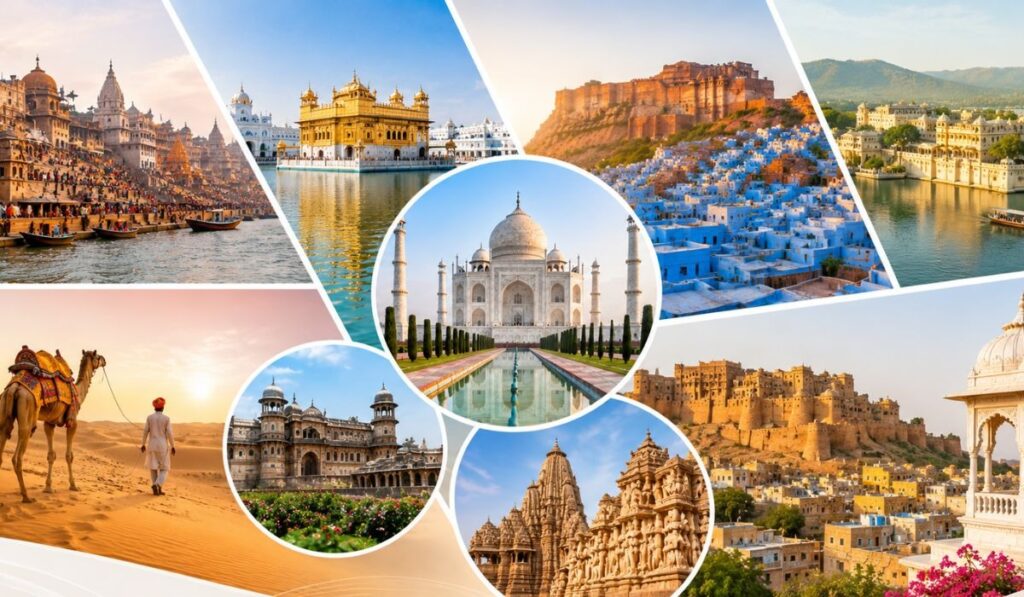
For those who want to go further, the same route can be extended into longer journeys — combined with Ranthambore’s tiger safaris, the spiritual ghats of Varanasi, the desert forts of Jodhpur and Jaisalmer, the lakes of Udaipur, the Golden Temple in Amritsar, the UNESCO temples of Khajuraho, or the sacred confluence at Prayagraj. Full details on all these itineraries are available on the Golden Triangle Tour Packages page.
Taj Mahal Tours
For travellers who only have a day or two to spare, a dedicated Taj Mahal trip is often the most practical choice — and it’s consistently one of the most-booked India tour packages from Delhi.
Taj Mahal Tour by Luxury Car — private, comfortable, and unhurried, ideal for those who want a premium experience.
Sunrise Taj Mahal Tour — timed to catch the monument at its most photogenic, before the crowds and heat set in.
Taj Mahal Tour by Superfast Train — a quicker, scenic alternative to driving, popular with travellers short on time.
Taj Mahal Tour from Delhi by Car — a straightforward same-day option covering Agra’s highlights with private transport.
Each of these focuses on convenience: skip-the-line entry, knowledgeable guides, and a same-day return to Delhi, so you don’t need to rearrange the rest of your trip around it. More options are listed under Taj Mahal Tour Packages.
Jaipur Tours
Jaipur, the Pink City, is Rajasthan’s most accessible introduction — close enough to Delhi for a day trip, yet rich enough in history to justify a longer stay.
Jaipur Tour by Train — a comfortable rail journey followed by a full day of sightseeing.
Full Day Jaipur Heritage Tour — a deeper dive into the city’s landmarks with a private guide.
Highlights typically include the hilltop Amber Fort, the ornate City Palace, the iconic pink facade of Hawa Mahal, and Jaipur’s bustling local markets, known for textiles, jewellery, and handicrafts. Browse the full range on the Jaipur Tour Packages page.
Delhi Tours
It’s easy to treat Delhi as just a transit point, but the city rewards a proper visit before you move on.
Old & New Delhi Tour — covers both the Mughal-era lanes of Old Delhi and the colonial-planned avenues of New Delhi in a single day.
Delhi Overnight Tour — for travellers arriving late or wanting a more relaxed, two-day introduction to the capital.
Spending time in Delhi first also helps with acclimatising — to the pace, the traffic, and the sheer scale of India — before heading into smaller cities. Full itineraries are available under Delhi Tour Packages.
Wildlife Tours
For travellers who want more than monuments, a wildlife detour adds a completely different dimension to a North India trip.
The Delhi to Ranthambore Tiger Safari Expedition takes travellers to one of India’s best-known tiger reserves, with multiple safari drives in search of the Royal Bengal Tiger alongside leopards, deer, and a wide variety of birdlife. The best safari season generally runs from October to June, with the warmer months between March and June often producing the strongest tiger sightings as animals gather near water sources. Details are available on the Wildlife Tour Packages page.
Extended India Tours
For travellers with two weeks or more, the Golden Triangle can be extended into a much larger circuit:
Golden Triangle with Prayagraj — combines the classic route with one of India’s holiest pilgrimage cities.
Golden Triangle with Amritsar — pairs Delhi, Agra, and Jaipur with the spiritual calm of the Golden Temple and the Wagah Border ceremony.
Golden Triangle with Jodhpur & Udaipur — adds Rajasthan’s blue city and its romantic lake palaces.
Golden Triangle with Jodhpur & Jaisalmer — extends into the Thar Desert, with forts, camel safaris, and golden dunes.
Golden Triangle with Gwalior, Orchha, Khajuraho & Tiger Safari — blends heritage architecture with a Ranthambore safari for a genuinely varied trip.
Royal Rajasthan Tour — an 18-day, in-depth journey through Rajasthan’s palaces, forts, and desert landscapes for travellers who want to see the state in real depth.
These longer tours suit travellers who’ve already done a shorter India trip, or first-timers who simply have the time and want to avoid returning too soon.
How to Choose the Right India Tour Package
With so many options, the right choice usually comes down to a few practical factors:
Budget: Shorter Golden Triangle tours and same-day trips are more economical, while extended multi-city itineraries and luxury car tours cost more but cover far more ground.
Duration: Have 3–4 days? Stick to the classic Golden Triangle. Have 10 days or more? Consider an extended tour with Rajasthan or wildlife add-ons.
Family vs. couples: Family itineraries benefit from a slightly slower pace with fewer early starts, while couples often prefer luxury car options or romantic destinations like Udaipur.
Solo travellers: Group-friendly, well-structured tours like the standard Golden Triangle packages tend to work best for solo travellers new to India.
First-time visitors: The 4 or 5-day Golden Triangle Tour is generally the easiest introduction — enough time to see the essentials without feeling rushed.
Luxury vs. budget travel: Decide early whether comfort (private luxury cars, higher-end hotels) or value is the priority, since it shapes almost every other choice.
Best season: Aligning your trip with the right months (more on this below) makes a bigger difference to comfort than almost anything else.
Best Time to Travel Around India from Delhi
October to March: The most popular window, with cool, dry weather that’s ideal for sightseeing in Delhi, Agra, Jaipur, and Rajasthan.
Summer (April–June): Hot and dry across North India, though this period can actually improve wildlife sightings in Ranthambore.
Monsoon (July–September): Fewer crowds and lush landscapes, but heavy rain can disrupt outdoor sightseeing and road travel.
Festival season: Diwali (October/November) and Holi (March) bring India’s culture to life, though these periods also see higher demand for hotels and transport, so booking ahead matters.
Travel Tips Before Booking
Clothing: Pack light, breathable layers for the day and something warmer for winter mornings and evenings, especially between November and February.
Cash: Carry some local currency for markets, small vendors, and tips, even though most hotels and larger shops accept cards.
SIM card: A local SIM or eSIM makes navigation, translation apps, and staying in touch with your guide far easier.
Local transport: Private cars are the most convenient way to move between cities, while trains are a comfortable, scenic alternative for shorter hops like Delhi–Agra or Delhi–Jaipur.
Tour guide: A knowledgeable local guide adds real context to sites like the Taj Mahal or Amber Fort — details you’d likely miss travelling independently.
Photography: Early morning visits (especially at the Taj Mahal) offer the best light and smaller crowds.
Entry tickets: Many major monuments, including several covered under UNESCO’s World Heritage listings, require pre-booked or skip-the-line tickets during peak season — worth confirming with your tour operator in advance.
Safety tips: Keep valuables secure in crowded markets, stay hydrated, and follow your guide’s advice around local customs and dress, particularly at religious sites.
FAQ – India tour packages
Which is the best India Tour Packages from Delhi?
It depends on your timeframe. First-time visitors usually do best with a 4 or 5-day Golden Triangle Tour, while travellers with more time often prefer an extended itinerary that adds Rajasthan or a wildlife safari.
How many days are enough?
A minimum of 3–4 days covers the classic Golden Triangle. For a more complete North India experience, 7–10 days allows for additional destinations like Ranthambore, Udaipur, or Amritsar.
Is the Golden Triangle worth visiting?
Yes — it remains India’s most popular circuit for a reason, combining three very different cities (a modern capital, a Mughal monument town, and a royal Rajasthani city) in a compact, manageable route.
Are private tours available?
Yes, most itineraries, including the Taj Mahal and Golden Triangle packages, are available with private transportation and a dedicated guide rather than a group setup.
Can I customize my itinerary?
Most operators, including India Beyond Travel, allow itineraries to be adjusted around travel dates, pace, and specific destinations based on your interests.
What is included in most India tour packages?
Typically, private transportation, accommodation, guided sightseeing, and monument entry assistance are included, though inclusions vary by package, so it’s worth checking each itinerary’s details.
What is the best season?
October to March offers the most comfortable weather for sightseeing across Delhi, Agra, Jaipur, and Rajasthan, while March to June can be better for tiger safaris in Ranthambore.
Are tours suitable for families?
Yes, most North India itineraries — from the Golden Triangle to Delhi and Jaipur tours — are designed to accommodate families, with flexible pacing and comfortable private transport.
Conclusion
Delhi’s combination of connectivity, history, and easy access to the rest of North India makes it the natural starting point for almost any India trip. Whether you’re after a quick 3-day Golden Triangle introduction, a deeper dive into Rajasthan’s palaces and deserts, or a wildlife detour to Ranthambore, there’s an itinerary built around your timeframe and interests. The best approach is simple: match the package to how much time you have, how you like to travel, and what you most want to see — and let Delhi do what it does best, connecting you to the rest of India.