
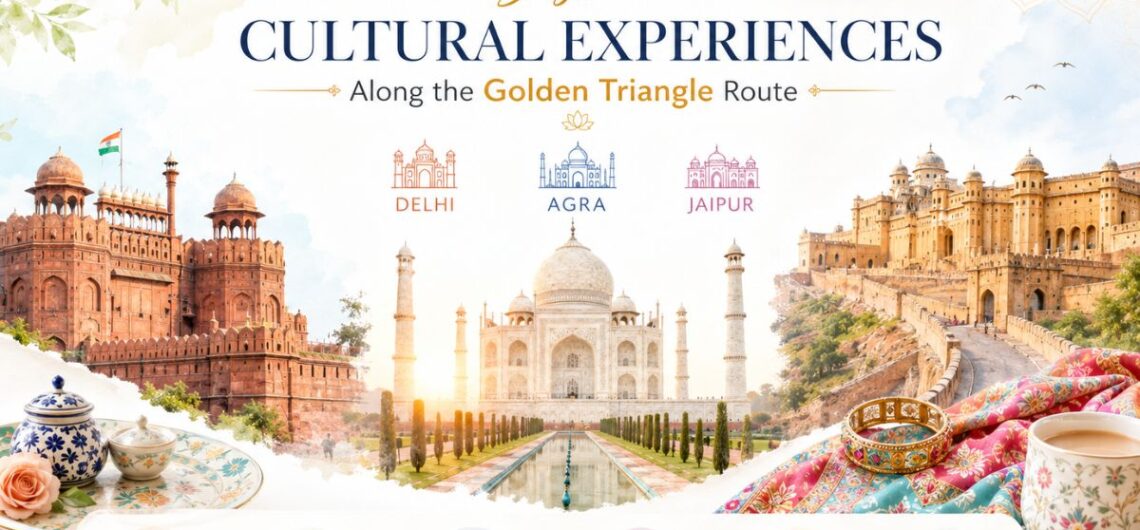
Most travelers first hear about the Golden Triangle as a route connecting three famous monuments: the Red Fort, the Taj Mahal and Amber Fort. But the Golden Triangle cultural experiences go far beyond these iconic landmarks, offering a journey through centuries of Indian culture — from Mughal courts and Rajput kingdoms to colonial history and everyday city life, all within a few hundred kilometers of each other.
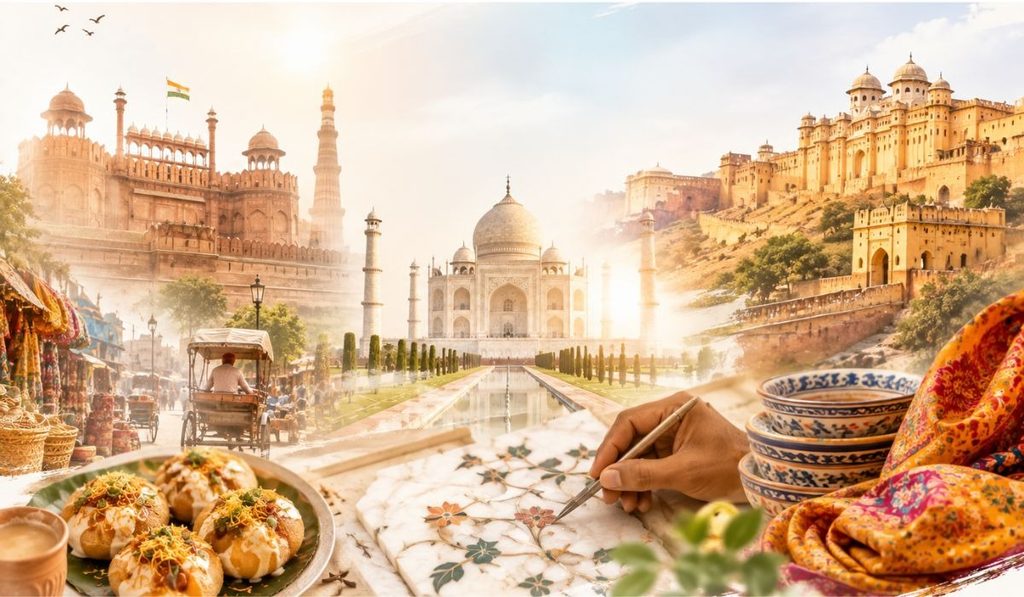
Seeing the monuments is only half the story. The best cultural experiences along the Golden Triangle route happen in the spaces between the sightseeing stops — in the smell of spices in a Delhi market, the tap of a chisel in an Agra marble workshop, or the color of block-printed cotton drying outside a Jaipur bazaar. Food, crafts, festivals, architecture and daily rituals all add depth to a trip that could otherwise feel like a checklist.
This guide looks at how travelers can experience the culture of Delhi, Agra and Jaipur, not just visit them, with practical suggestions for food, markets, heritage sites and etiquette along the way.
What Makes the Golden Triangle a Cultural Journey?
Each city on the route carries a distinct cultural identity, shaped by different rulers, geography and traditions.
| Destination | Cultural Identity |
| Delhi | Mughal, colonial and modern Indian culture |
| Agra | Mughal heritage, marble craftsmanship and local traditions |
| Jaipur | Rajput heritage, crafts, cuisine and Rajasthani traditions |
Traveling between the three cities means moving through layers of history rather than a single narrative. In practical terms, this shows up in everyday details: the architecture on a street corner, the ingredients used in a local dish, the pattern on a hand-block-printed scarf, or the melody drifting from a temple courtyard. Visitors who pay attention to these details — alongside religious heritage, festivals, traditional clothing and handicrafts — come away with a far richer picture of India than a monument-only itinerary can offer.
Best Cultural Experiences in Delhi
Delhi’s culture is built in layers. Mughal-era monuments sit close to colonial-era buildings, and both exist alongside a fast-moving modern capital.
Explore Old Delhi’s Historic Streets
Old Delhi, centered around Chandni Chowk, is one of the best places to feel the city’s older rhythms. The narrow lanes are lined with historic havelis, small workshops and family-run shops that have operated for generations. Wandering here — rather than rushing through — reveals how commerce, religion and daily life overlap in a small area.
Near the Jama Masjid, the streets fill with vendors, spice traders and worshippers, especially around prayer times. A slow walk through this part of the city, ideally with a knowledgeable guide, gives context that’s easy to miss on a quick drive-by.
Experience Delhi’s Mughal Heritage
Delhi’s Mughal history is visible in sites like the Red Fort, Jama Masjid and Humayun’s Tomb. Each reflects a different stage of Mughal architecture and ambition. The Red Fort was the seat of Mughal power for centuries, Jama Masjid remains one of India’s largest working mosques, and Humayun’s Tomb is often cited as an early influence on the design later refined in the Taj Mahal. Understanding this progression helps travelers see these sites as part of a connected story rather than isolated attractions.
Try Traditional Delhi Food
Delhi’s food culture is one of its most accessible entry points into local life. Parathas stuffed with potatoes or paneer, chaat with its mix of tangy and spicy flavors, kebabs rooted in Mughlai cuisine, and traditional sweets are all part of the everyday food landscape. For street food, it’s worth choosing vendors that are visibly busy with local customers and maintain clean preparation areas — a good, simple way to balance an authentic experience with food safety.
Explore Delhi’s Markets and Handicrafts
Markets across Delhi offer a hands-on introduction to Indian textiles, jewelry, spices and handicrafts. Traditional clothing, embroidered fabrics and regional spice blends are common finds, and even browsing without buying gives a sense of the variety of craft traditions represented in the capital.
Best Cultural Experiences in Agra
Agra is often treated as a single-stop city built around the Taj Mahal, but its cultural offerings extend well beyond that one monument.
Learn the Story Behind Mughal Architecture
The Taj Mahal, Agra Fort and Itmad-ud-Daulah together tell a fuller story of Mughal architectural evolution — from the red sandstone fortifications of Agra Fort to the intricate marble work of Itmad-ud-Daulah, sometimes called the “Baby Taj,” and finally the refined symmetry of the Taj Mahal itself. Knowing the history behind each site — who built it, why, and what came before it — turns a photo stop into a more meaningful visit.
Discover Agra’s Marble Inlay Craft
Agra is closely associated with pietra dura, the marble inlay technique used to decorate the Taj Mahal with semi-precious stones set into white marble. This craft is still practiced by artisan families in the city today, many of whom trace their skills back generations to the original craftsmen. Visiting a workshop to watch marble being cut, shaped and inlaid by hand offers a direct connection to the techniques behind Agra’s most famous monument.
Explore Agra’s Local Markets
Agra’s markets are known for marble souvenirs, leather products, handicrafts and traditional artwork. Shopping here can be a genuinely interesting cultural activity, especially when browsing artisan-made pieces, but it’s worth treating it as optional rather than a mandatory part of the visit. A little familiarity with local shopping etiquette — polite bargaining, comparing a few shops, and taking time rather than buying under pressure — makes the experience more enjoyable.
Taste Agra’s Local Cuisine
Petha, a translucent sweet made from ash gourd, is Agra’s best-known local specialty, alongside Mughlai dishes, savory snacks and traditional sweets found throughout the old city. Trying a few of these dishes is an easy way to connect food back to the city’s Mughal-era roots.
Best Cultural Experiences in Jaipur
Of the three cities, Jaipur offers the most immersive window into Rajasthan’s royal and folk traditions.
Explore Jaipur’s Royal Heritage
Amber Fort, City Palace, Hawa Mahal and Jantar Mantar each reflect a different aspect of Rajput and royal Jaipur. Amber Fort showcases military architecture blended with palace design, City Palace remains a living link to the former royal family, Hawa Mahal was built for royal women to observe street life while remaining unseen, and Jantar Mantar reveals the scientific ambitions of Maharaja Jai Singh II through its astronomical instruments. Together, these sites illustrate how Jaipur’s rulers balanced power, culture and knowledge.
Walk Through Jaipur’s Traditional Markets
Jaipur’s bazaars, especially Johari Bazaar and Bapu Bazaar, are known for jewelry, textiles, block-printed fabrics and handicrafts. These markets aren’t just for shopping; they’re a working demonstration of skills passed down through generations of local artisan families.
Experience Rajasthani Handicrafts
Jaipur is a center for block printing, blue pottery, jewelry-making and textile work. Many of these crafts can be observed directly, whether through a workshop visit or a market stall where artisans work in view of visitors, giving a closer look at techniques that have shaped Rajasthani design for centuries.
Taste Traditional Rajasthani Food
Dishes like Dal Baati Churma, Gatte ki Sabzi, Ker Sangri and Ghevar reflect Rajasthan’s desert geography and culinary traditions. A traditional Rajasthani thali, which typically includes several of these dishes together, is one of the simplest and most complete ways to experience regional food culture in a single sitting.
10 Cultural Experiences You Should Not Miss
1. Explore Old Delhi’s historic lanes — Wander through Chandni Chowk to see how commerce, faith and daily life intersect in one of Delhi’s oldest neighborhoods.
2. Taste traditional Indian street food — Sample parathas, chaat and kebabs from busy, reputable vendors for an authentic (and safe) taste of local flavors.
3. Visit Mughal heritage sites — See how Mughal architecture evolved from the Red Fort in Delhi to the Taj Mahal in Agra.
4. Discover Agra’s marble inlay craftsmanship — Watch artisans practicing the pietra dura technique that decorates the Taj Mahal.
5. Explore Agra’s traditional markets — Browse marble work, leather goods and handicrafts at a relaxed, no-pressure pace.
6. Learn about Jaipur’s Rajput heritage — Understand the history behind Amber Fort, City Palace and Hawa Mahal.
7. Visit Jaipur’s traditional bazaars — See block printing, jewelry-making and textile crafts up close in Johari and Bapu Bazaar.
8. Experience Indian handicrafts — From blue pottery to embroidered textiles, handicrafts connect travelers directly to regional artisan traditions.
9. Try regional cuisine in each city — Each city’s food tells a different cultural story, from Mughlai dishes to Rajasthani thalis.
10. Attend a cultural performance or local celebration when available — Folk music, dance performances or a local festival can add a memorable, spontaneous layer to the trip.
How to Experience the Golden Triangle Beyond Sightseeing
There’s a real difference between “seeing India” and “experiencing India.” The first involves checking off monuments; the second means engaging with the culture around them. A few practical habits make that shift easier:
Hire knowledgeable local guides who can explain context, not just facts
Spend unstructured time in local markets rather than rushing through
Try regional food instead of sticking to familiar options
Visit artisan workshops to see traditional crafts in progress
Ask before photographing people
Respect religious customs at temples, mosques and shrines
Learn a few basic Hindi phrases
Avoid rushing between attractions
Leave room in the itinerary for spontaneous experiences
None of these require extra planning skill — mostly, they require slowing down.
Golden Triangle cultural experiences by Trip Duration
How much cultural depth a traveler can experience often comes down to time.
3-Day Golden Triangle Trip
A three-day trip covers the major landmarks in each city. The schedule is tighter, leaving less time for markets and workshops. You can still enjoy street food in Delhi, a marble workshop in Agra, and a bazaar walk in Jaipur. Plan cultural stops alongside the main sights. A 3-day Golden Triangle itinerary can help you balance cultural experiences with sightseeing.
5-Day Golden Triangle Trip
An extra two days makes a noticeable difference. With five days, travelers can slow down in markets, spend more time with artisans, try a wider range of regional food, and explore neighborhoods beyond the main tourist areas in each city. This extra breathing room is often what separates a trip that feels rushed from one that feels genuinely immersive. A 5-day Golden Triangle itinerary is a useful starting point for travelers who want that additional depth without an open-ended schedule.
Longer Golden Triangle Experience
A longer itinerary gives travelers more time to explore. You can revisit favorite markets or attend local festivals. There is also more time to connect with guides and artisans. An extended trip offers greater flexibility for cultural experiences. Explore a full Golden Triangle tour to plan a longer cultural journey.
Best Time for Cultural Experiences Along the Golden Triangle
October to March brings the most comfortable weather for walking through markets, old city lanes and outdoor heritage sites, making it a popular window for cultural exploration.
April to June is considerably hotter across all three cities. Outdoor cultural activities are still possible, but mornings and evenings tend to be more comfortable than the middle of the day.
July to September brings the monsoon. Conditions vary by location and year, but the season often brings a different atmosphere and photography opportunities, along with the practical need to plan around rain.
Cultural Etiquette for Travelers in Delhi, Agra and Jaipur
A little cultural awareness goes a long way in Delhi, Agra and Jaipur:
A little cultural awareness goes a long way in Delhi, Agra and Jaipur:
Dress respectfully when visiting religious sites
Remove shoes where required
Ask permission before photographing people
Avoid touching religious objects without permission
Respect local customs, especially in smaller neighborhoods
Bargain politely in markets rather than aggressively
Avoid wasting food, particularly at shared or traditional meals
Follow monument rules and posted guidelines
Be respectful and quiet during religious ceremonies
How to Plan a More Authentic Golden Triangle Experience
Don’t schedule every hour — leave room to explore.
Include at least one local food experience per city.
Visit a traditional market, not just monuments.
Learn about local crafts before you arrive, so you recognize what you’re seeing.
Spend time with a knowledgeable local guide.
Explore beyond the most famous monuments in each city.
Choose experiences based on your own interests, not just popular checklists.
Keep cultural sensitivity in mind throughout the trip.
Frequently Asked Questions
What are the best cultural experiences on the Golden Triangle route?
The Golden Triangle cultural experiences include exploring Old Delhi, tasting regional cuisine, visiting Agra’s marble workshops, exploring Jaipur’s traditional bazaars, learning about Mughal and Rajput heritage, and experiencing India’s traditional crafts. Together, these go beyond monument visits and offer a fuller picture of daily life and history in each city.
Which city has the richest cultural experiences: Delhi, Agra or Jaipur?
Each city offers a different kind of cultural depth. Delhi blends Mughal, colonial and modern influences; Agra centers on Mughal heritage and marble craftsmanship; Jaipur offers the most immersive Rajput and Rajasthani folk traditions. Rather than one being “richest,” they complement each other across the route.
What traditional food should I try on the Golden Triangle?
Delhi is known for parathas, chaat and kebabs. Agra is famous for petha and Mughlai dishes, while Jaipur offers Dal Baati Churma, Gatte ki Sabzi and Ghevar. A traditional thali is a great way to sample several regional dishes in one meal.
What handicrafts can I buy in Agra and Jaipur?
Agra is known for marble inlay work, leather goods and handicrafts reflecting its Mughal artisan traditions. Jaipur offers block-printed textiles, blue pottery, jewelry and embroidered fabrics rooted in Rajasthani craft traditions. Both cities offer workshop visits alongside shopping opportunities.
Is the Golden Triangle suitable for first-time visitors to India?
Yes, the Golden Triangle is one of the most common routes for first-time visitors because it combines major historical sites with accessible infrastructure across Delhi, Agra and Jaipur. It also offers a manageable introduction to India’s cultural diversity without requiring extensive travel between regions.
How many days are best for experiencing the Golden Triangle?
Three days covers the core highlights, while five days or more allows for a slower pace with more time in markets, workshops and local neighborhoods. The right length depends on how much cultural depth, rather than just sightseeing, a traveler wants to prioritize.
Can I experience local culture on a 3-day Golden Triangle trip?
Yes, though the pace is faster. A well-planned three-day itinerary can still include a street food stop, a market visit and an artisan workshop alongside the major monuments, even if there’s less time to linger in each place.
What should I wear when visiting cultural and religious sites?
Modest, respectful clothing is recommended, particularly at temples, mosques and other religious sites — generally covering shoulders and knees. Comfortable walking shoes are also useful, since many cultural experiences involve walking through markets and old city lanes.
Final Thoughts
The Golden Triangle is often introduced as a route between three famous monuments, but its real value lies in everything around them: the food, the crafts, the markets, the architecture, the history and the everyday life of Delhi, Agra and Jaipur. Travelers who make room for these experiences, alongside the major heritage sites, tend to come away with a much richer sense of the region.
Whether you have three days or five, planning some time for cultural experiences can make a Delhi–Agra–Jaipur journey much more memorable. If you’re still deciding how to structure your trip, our complete guide to Golden Triangle tours can help you understand the route, sightseeing priorities and itinerary options.

Comments