
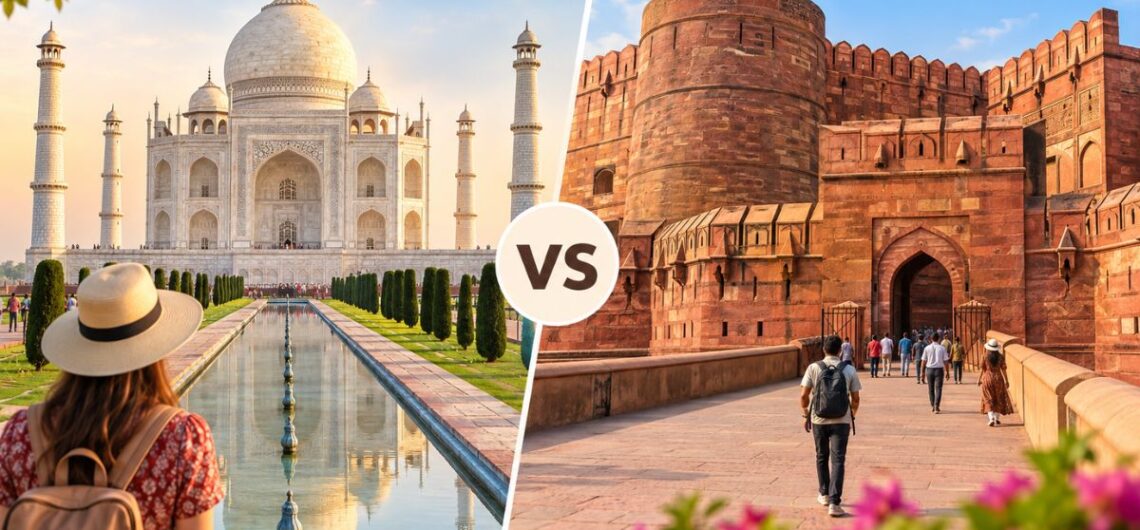
The Taj Mahal and Agra Fort are two of Agra’s most important Mughal monuments, but they served very different purposes. Shah Jahan built the Taj Mahal as a monumental mausoleum in memory of Mumtaz Mahal, while Mughal rulers developed Agra Fort as a fortified imperial complex and royal residence. Their purpose, architecture, materials, history, and visitor experience differ significantly, even though both stand on the banks of the Yamuna River just a few kilometers apart.
Many travelers visit both on the same trip, and for good reason: together they offer two very different windows into Mughal history — one memorial, one imperial.
Taj Mahal vs Agra Fort at a Glance
| Feature | Taj Mahal | Agra Fort |
| Primary purpose | Mausoleum | Fortified palace and imperial complex |
| Main historical association | Shah Jahan | Akbar and later Mughal rulers |
| Main material | White marble | Red sandstone with marble elements |
| Location | Yamuna River | Yamuna River |
| Architectural character | Symmetrical, ornamental | Defensive, palatial, and monumental |
| Main experience | Monument, gardens, marble craftsmanship | Fortifications, palaces, courtyards, and history |
| UNESCO status | World Heritage Site | World Heritage Site |
Neither monument is objectively “better” than the other — they simply represent different sides of the same empire.
What Is the Taj Mahal?
In simple terms, the Taj Mahal was designed primarily as a monumental mausoleum and memorial, combining architecture, gardens, and decorative craftsmanship into a highly symmetrical complex.
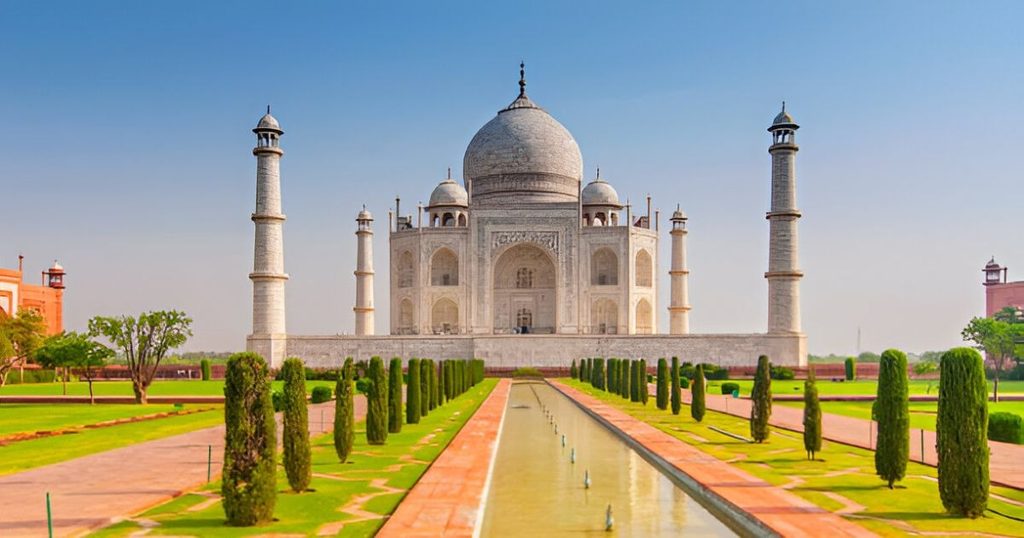
Shah Jahan commissioned it in the 17th century in memory of his wife, Mumtaz Mahal, who died during childbirth. Built almost entirely from white marble, the complex follows a strict charbagh (four-part garden) layout, with the mausoleum itself set at one end rather than the center — a deliberate design choice that frames the building against the sky and the Yamuna behind it.
Its signature elements include a large central dome flanked by four minarets, intricate pietra dura inlay work using semi-precious stones, and calligraphy bands drawn from the Quran. Every part of the complex, from the gateway to the gardens, was planned around symmetry and proportion, reinforcing its role as a work of memorial art rather than a functional palace.
What Is Agra Fort?
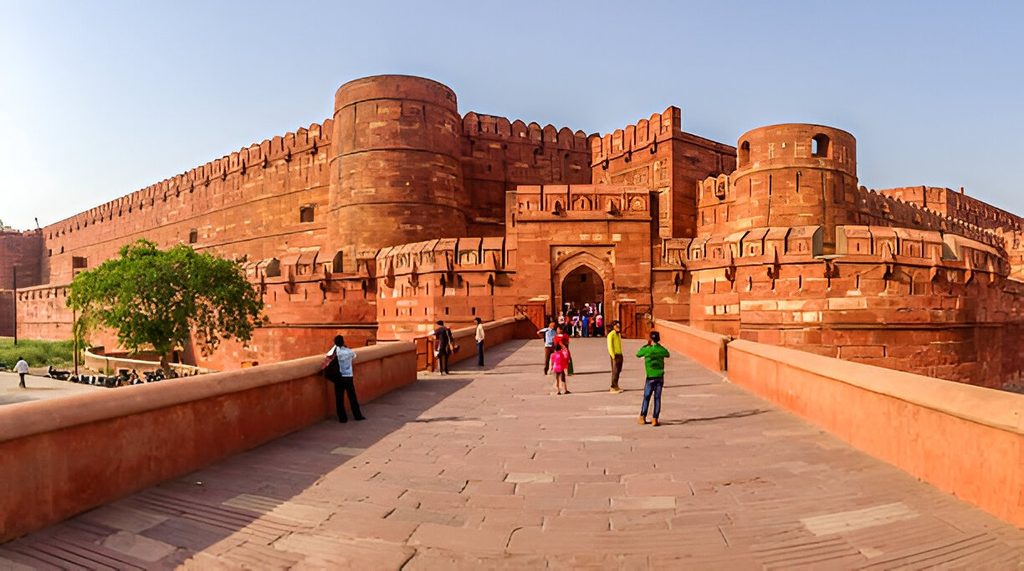
Agra Fort developed over generations as a fortified imperial complex, not a single building built for one purpose. Emperor Akbar substantially rebuilt it in red sandstone starting in 1565, transforming an earlier fort into a proper seat of Mughal power, and later rulers, especially Shah Jahan, added marble palaces within its walls.
Behind its nearly 2.5-kilometer defensive perimeter, the fort contains far more than military architecture. It houses royal residences, formal audience halls, mosques, and gardens, all built to support the day-to-day functioning of an empire — governance, court ceremony, and royal domestic life together in one walled city.
That combination is what makes Agra Fort more than a military structure: it functioned simultaneously as a fortress, a royal residence, and the administrative center of the Mughal Empire for well over a century.
Taj Mahal vs Agra Fort: The Biggest Differences
1. Purpose
This is probably the most important distinction between the two monuments. The Taj Mahal was built primarily as a mausoleum and memorial — a single-purpose structure created to honor Mumtaz Mahal. Agra Fort, by contrast, was a fortified imperial complex that functioned as a royal residence and center of government, serving practical, political, and defensive needs rather than a commemorative one.
2. Historical Timeline
Agra Fort has a much longer development history than the Taj Mahal. Akbar substantially rebuilt the fort in the 16th century, and later Mughal rulers, including Jahangir and Shah Jahan, continued modifying and expanding parts of it over the following decades. The Taj Mahal, by comparison, belongs principally to a single period: Shah Jahan’s 17th-century reign, with construction generally dated to the 1630s and 1640s.
3. Architecture
| Taj Mahal | Agra Fort |
| Symmetry | Massive walls |
| White marble | Gates |
| Central dome | Courtyards |
| Minarets | Palaces |
| Decorative inlay | Audience halls |
| Formal gardens | Sandstone and marble |
The Taj Mahal’s architecture is unified and singular in intent — every element supports its role as a memorial. Agra Fort’s architecture, by contrast, layers defensive, residential, and ceremonial structures side by side, reflecting its role as a working imperial complex rather than a single monument.
4. Building Materials
It’s not simply a case of “the Taj Mahal is white and Agra Fort is red.” White marble gives the Taj Mahal a luminous, ethereal quality that shifts with the light throughout the day — part of why sunrise and sunset visits are so popular. Red sandstone, by contrast, gives Agra Fort a heavier, more fortified presence that suits its original defensive role. Shah Jahan’s later marble additions inside the fort — Khas Mahal, Diwan-i-Khas, Musamman Burj — introduce the same refined material into a structure otherwise built for strength rather than display, visually marking where the fort shifted from military stronghold to royal residence.
5. Visitor Experience
At the Taj Mahal, the experience centers on the iconic monument itself: the gardens, the approach through the main gateway, close-up architectural and inlay details, and a generally reflective, memorial atmosphere.
At Agra Fort, the experience is broader and more exploratory — large courtyards, palace interiors, defensive walls and gates, and, from select points like Musamman Burj, views across the river toward the Taj Mahal. Visitors generally come away from Agra Fort with a deeper sense of Mughal imperial and court life than the Taj Mahal alone provides.
Why Visit Agra Fort After the Taj Mahal?
Agra Fort helps provide historical context for the Taj Mahal and the broader Mughal period. Seeing both allows travelers to understand the contrast between memorial architecture and imperial architecture, rather than treating the two monuments as unrelated stops on an Agra itinerary.
Shah Jahan is the connecting figure: he added the fort’s marble structures and later commissioned the Taj Mahal, and was eventually confined within the fort during his final years, within view of the mausoleum he built. Travelers who want to experience this fuller Agra story alongside Delhi and Jaipur can explore India Beyond Travel’s Golden Triangle Tour Packages for different itinerary lengths and travel styles.
Can You Visit the Taj Mahal and Agra Fort on the Same Day?
Yes, visiting both in one day is practical for many travelers. A typical approach starts early, with the Taj Mahal first for those interested in morning light and cooler temperatures, followed by breakfast or a short rest, then Agra Fort afterward. Travelers with extra time can add Mehtab Bagh or another Agra attraction if the schedule allows, though it’s worth keeping the day realistic rather than overpacking it.
For travelers coming from Delhi, the Sunrise Taj Mahal and Agra Tour by Car is built specifically around this pattern — an early Taj Mahal visit followed by time to explore Agra Fort the same day.
How Much Time Do You Need for Each?
Taj Mahal: Allow enough time for entry and security procedures, the gardens, the mausoleum area itself, architectural details up close, and photography. Most visitors spend between one and two hours here.
Agra Fort: Allow time to move through the gates and courtyards, explore the palace structures and audience halls, and take in the viewpoints toward the Taj Mahal. A comfortable visit typically runs 1.5 to 2 hours, longer for travelers interested in architecture and history.
Queues, visitor interest, and seasonal conditions can all affect these timings, so treat them as a starting point rather than a fixed rule.
Which One Should You Visit First?
Rather than one universal answer, it depends on what your itinerary and interests prioritize.
Option 1: Taj Mahal First. Best suited to travelers who want early morning light, a cooler sightseeing start, sunrise-focused photography, or simply want the Taj Mahal as the first major stop of the day.
Option 2: Agra Fort First. Can work well when your schedule starts later, when you’d rather understand Mughal history before seeing the Taj Mahal, or when ticket timings and logistics make this order more practical.
For many first-time visitors, seeing both is more useful than choosing between them, because each monument represents a different side of Agra’s Mughal heritage.
Taj Mahal vs Agra Fort: Which Is More Important Historically?
“Importance” here really depends on what a traveler wants to understand. The Taj Mahal represents Mughal memorial architecture, decorative craftsmanship, and the personal and artistic legacy of Shah Jahan’s reign. Agra Fort represents Mughal political power, imperial residence, military architecture, and generations of court life. The two monuments simply illuminate different aspects of the same empire, so visiting both provides a broader understanding of Agra’s Mughal heritage than either one alone.
How They Fit Into an Agra Itinerary
A short Agra visit might look like this:
- Early morning: Taj Mahal
- Morning: Breakfast
- Late morning: Agra Fort
- Afternoon: Lunch or a local experience
- Optional: Mehtab Bagh or another attraction
- Evening: Return to Delhi, or overnight in Agra
Travelers with more time can expand this into a longer Agra stay or fold it into a broader multi-city trip.
Taj Mahal and Agra Fort in a Golden Triangle Tour
Both monuments fit naturally into the classic Delhi–Agra–Jaipur Golden Triangle route, where Agra sightseeing typically covers the Taj Mahal, Agra Fort, and sometimes Mehtab Bagh as part of a single city stop. India Beyond Travel’s Golden Triangle itineraries are built around this pattern, with multiple lengths and extensions depending on how much time you have.
Can You See Both on a 3-Day Golden Triangle Tour?
Yes. A short Golden Triangle itinerary can still comfortably include Delhi, Agra, and Jaipur, with the Agra portion covering both major Mughal monuments. The 3 Days Golden Triangle Tour specifically includes the Taj Mahal and Agra Fort during its Agra stop.
Practical Tips for Visiting Both Monuments
- Start early when possible, especially in warmer months.
- Wear comfortable walking shoes — both sites involve significant walking.
- Carry water, particularly outside the cooler season.
- Allow time for security procedures at both entrances.
- Check current monument entry rules before visiting.
- Avoid packing too many attractions into one morning.
- Keep some flexibility in the itinerary for queues or weather.
- Consider a knowledgeable local guide for deeper historical context.
- Respect photography and visitor restrictions where applicable.
Frequently Asked Questions
Is Agra Fort older than the Taj Mahal?
Yes, in its Mughal form. Akbar rebuilt Agra Fort starting in 1565, roughly seven decades before Shah Jahan began the Taj Mahal in the 1630s, though an earlier fortification existed at the fort’s site before that.
Is Agra Fort inside the Taj Mahal complex?
No. They are separate monuments in Agra, located roughly 2.5 kilometers apart on the same side of the Yamuna River.
Can I visit the Taj Mahal and Agra Fort in one day?
Yes. Most travelers visit the Taj Mahal in the early morning, then move to Agra Fort afterward, leaving the afternoon free for lunch or an additional stop.
Which is bigger, the Taj Mahal or Agra Fort?
“Bigger” can be misleading here, since they’re fundamentally different types of complexes. Agra Fort covers a much larger walled area with multiple palaces and courtyards. In contrast, the Taj Mahal is a single mausoleum set within a smaller, more contained garden complex.
Why was Agra Fort built?
It was built and expanded to serve defensive, residential, and administrative functions for the Mughal Empire, combining a military stronghold with a royal residence and center of government.
Why was the Taj Mahal built?
It was built as a mausoleum and memorial, commissioned by Shah Jahan in honor of his wife, Mumtaz Mahal.
How far is Agra Fort from the Taj Mahal?
The two sites are approximately 2.5 kilometers apart, a short drive or a longer walk along the riverside. Confirm current route details when planning your visit, since local traffic patterns can vary.
Should I visit both Taj Mahal and Agra Fort?
For travelers interested in Agra’s Mughal heritage, seeing both is worthwhile. Each offers a different experience—one is memorial and artistic, while the other is imperial and historical.
Final Thoughts
The Taj Mahal and Agra Fort aren’t competing attractions; they’re complementary pieces of the same Mughal story. One shows the empire’s artistic and memorial ambitions, the other its political and residential reality. Planning to visit both monuments? Explore India Beyond Travel’s Golden Triangle itineraries. See how the Taj Mahal and Agra Fort fit naturally into a Delhi–Agra–Jaipur journey.

Comments